Editorial Record: This article was originally submitted as an AEJMC Public Relations
Division GIFTs paper, with a February 2023 deadline. Top papers were submitted to
JPRE June 2023, and accepted for publication at that time. Published January 2024.
Author

Lindsey A. Sherrill, Ph.D.
Assistant Professor Business Communication
Management and Marketing
University of North Alabama
Alabama, USA
Email: lsherrill2@una.edu
Overview of the Assignment:
This assignment gamifies the often tedious and boring—for both teachers and learners—process of enforcing and practicing writing style standards. The instructions and examples in this document are for teaching APA style, though the game could be adapted for Associated Press style, MLA, Chicago, etc. This assignment can also be adapted for synchronous online classes.
Learning writing style standards is a necessary but tedious part of training students to write appropriately. By making practice fun and collaborative through gamification, students are more likely to engage with the material (Sailer & Homner, 2020) and retain knowledge beyond the exercise.
Student Learning Goals:
Students leave the activity having practiced and enforced elements and rules of a writing style, including 1) knowing how to find answers to style questions and 2) how to apply the rules to various audiences and situations.
Connections to Practice/Theory:
Using appropriate style for the audience and situation is a vital part of professionalism for writers. This exercise can be adapted to using Associated Press style, a vital tool for PR practitioners in getting their releases published, as well as for practicing APA or other writing styles necessary for students pursuing graduate school or research opportunities.
Evidence of Student Learning Outcomes:
- Students report, both anecdotally and in evaluations, that this is the best day of class.
- 2022 Assurance of Learning data for the course showed that over 2/3 of students met or exceeded expectations for using citations and other style elements appropriately at the end of this course.
Implementation/How to Play:
- Students are divided into teams of roughly 3-6 students (in my classroom, students work in project teams assigned earlier in the semester). Each team is given markers, and either assigned a section of the white board or given a poster-sized Post-It sheet on the wall. Teams are spread around the room to allow each team room to discuss and write independently.
- Students are encouraged to use style guides, class handouts, or online resources to find answers, but must do so within the time limit.
- Questions are divided into two groups, “Short Answer” (1 point) questions and “On the Board” (1-5 point) questions.
- The Short Answer questions are played via Kahoot! software. These questions involve quick multiple-choice answers, and the top 3 teams (or students, if played individually) at the end of the Kahoot! section receive bonus points at the end of the game. Depending on the size of the class, the Short Answer section can be played as teams or as individual students.
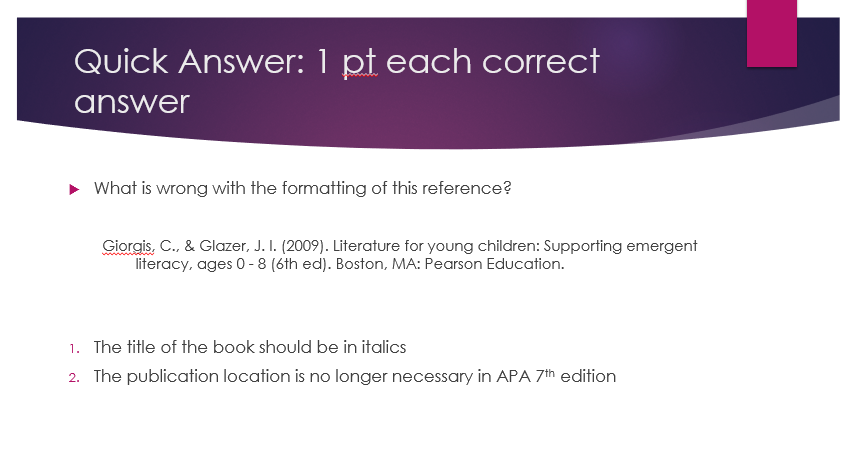
- For the On the Board section, questions related to the chosen style are projected via a PowerPoint presentation at the front of the classroom (see Appendix). Some of these questions include a bonus “short answer” component. For bonus questions, teams are allowed to raise hands or “buzz in” to respond. If the first team misses a short answer question, another team may answer and “steal” the point. For On the Board questions, all teams may receive points, including partial credit. Points are awarded based on number of mistakes—5 points for no mistakes, 4 points for a single mistake, etc. In order to maximize the number of questions possible in a class period, I usually allow 1-5 minutes per On the Board question, depending on the complexity of the answer.
- Scoring will depend on class and room size. For small classes, I usually circulate the room and discuss each team’s responses and award points. For larger classes or rooms, I project the correct answer on the board and have students self-score–I have found that they are much harder on themselves than I am!
- At the end of the class period, each team keeps however many points they have earned as extra credit points for the class, and I award the top team(s) an additional prize (university branded swag, candy, fun pens, etc.).
Reference
Sailer, M., & Homner, L. (2020). The gamification of learning: A meta-analysis. Educational Psychology Review 32(1), 77-112. https://doi.org/10.1007/s10648-019-09498-w.
Appendix:
APA Style Kahoot! Short Answer Example:


On the Board Long Answer Examples:


On the Board Bonus Point Examples:

© Copyright 2024 AEJMC Public Relations Division
To cite this article: Sherrill, Lindsey A. (2024). APA Style: The Game. Journal of Public Relations Education, 9(2), 68-74. https://journalofpreducation.com/?p=4064