Editorial Record: This article was originally submitted as an AEJMC Public Relations Division GIFTs paper, with a February 2023 deadline. Top papers were submitted to JPRE June 2023, and accepted for publication at that time. Published January 2024.
Author
Sumin Fang, Ph.D. Assistant Professor School of Communication University of the Fraser Valley Canada Email: sumin.fang@ufv.ca
Crowdsourcing has now been widely used as an innovative way to engage publics by public relations practitioners (Park & Kang, 2020; Sommerfeldt et al., 2019). Crowdsourcing refers to the phenomenon that organizations openly seek solutions, feedback, or voting for its challenges and problems from a wide range of audience members on digital platforms, such as social media and organizational websites (Brabham, 2008; Ghezzi et al., 2018; Hossain & Kauranen, 2015; Howe, 2006).
Overview of the assignment
This assignment (see Appendix) was assigned when city A, where our university is located, experienced an unprecedented flood in November 2021. Thousands of people had to evacuate, and a total financial loss was over four million dollars. I asked students to design crowdsourcing social media campaigns for local communities and organizations. The goal was to attract traffic to these organizations’ websites, raise public awareness of important social issues caused by this emergency, help with the sales of the products from impacted farms, solicit solutions to evacuate the farm animals, seek crisis preparation strategies, or elicit solutions to manage floods in the future. Students needed to provide campaign goals, messages and images, justify its launch channels, major stakeholders, and public engagement for the campaigns.
Student learning goals
1.Understand how and why crowdsourcing campaigns are different from other social media campaigns.
2. Draft crowdsourcing social media campaigns to help local communities attract public attention and aid.
3. Apply your understanding of audience analysis and the media environment to communications planning and deployment.
4. Describe the flow and distribution of information and communications during a local community’s real-life scenario.
Rational and Connection to PR Theory and Practice
Crowdsourcing campaigns may be an announcement of a challenge to call for public proposals, a current policy or solution to seek public feedback, an invitation for publics to vote for their favorite option, an interesting contest on social media to engage publics, and a small task to be fulfilled by publics for societal good.
Public relations educators call for more up-to-date experiential social media training to prepare students for the dynamic digital world and job markets (e.g., Fraustino et al., 2015; Stansberry, 2016). Both research and real-life practices show crowdsourcing has been used for public good, such as stopping drug abuse, promoting health behaviors, and advocating organizational CSR (Ahmad, 2022; Braham, 2015; Conrad et al., 2020; Park & Kang, 2020). Little literature has reported how public relations educators guide students to develop crowdsourcing social media campaigns for local communities in a real-life emergency.
Evidence of student learning outcomes
Students appreciated this experiential learning opportunity to contribute to the local city creatively. Some students created a Twitter contest to invite new proposals on how the local government could manage future floods. Some invited audiences to participate in a naming contest for animals in the local shelter and newborn calves in the flood-impacted farms. Some social media campaigns called for new recipe ideas to use apples and berries from local organic farms. This assignment helped students to identify and design crowdsourcing campaigns. After this course, some students reported developing engage crowdsourcing campaigns in their internships, which received unprecedented traffic to the organizational accounts.
Takeaways
I recommend instructors first help students distinguish crowdsourcing and non-crowdsourcing campaigns. Before students design crowdsourcing campaigns, instructors could show a few mixed campaign messages from both types to the students and lead a class discussion. I suggest the following major differences between crowdsourcing and non-crowdsourcing campaigns.
Crowdsourcing campaigns invite people to comment or submit their feedback or solutions in the comment section, whereas ordinary campaigns often present themselves in one-way communication, such as announcements. For example, “What are your recipes to create a healthy breakfast with our farm’s organic blueberries? We cannot wait to hear from you.” It is a crowdsourcing campaign because the campaign message encourages the audience to share their recipes publicly on the comment section with everyone. In contrast, “Come to join us for a blueberry tasting festival on November 30” is a non-crowdsourcing campaign because the audience is not expected to take communicative actions immediately.
Because crowdsourcing campaigns aim to pick the mind of the public, they often appear in the form of questions. Ordinary campaigns usually end with a period. For example, it is a crowdsourcing campaign that uses “What name would you give to this calf born during the flood emergency two weeks ago?” The following campaign is not crowdsourcing because it just states an event without inviting people to initiate communicative behaviors on social media: “We look forward to seeing you at the flood donation event this Friday.”
Crowdsourcing campaigns usually give out incentives to the participants. Instructors should encourage students to describe the incentives clearly and concisely in the campaign message. Incentives may include social media acknowledgments of the best contributor(s), gift cards, product samples and swags, an on-site tour of the organization, trips for vacations, cash rewards, and so on. The class can discuss which incentives would best fit the campaigns.
References
Ahmad, J. (2022). Crowdsourcing potential: Developing the right formula for the prevention and intervention strategy against drug abuse in Malaysia. In D. Moss & B. DeSanto (Eds.), Public relations cases: International perspectives (pp. 24-33). Routledge.
Brabham, D. C. (2008). Crowdsourcing as a model for problem solving: An introduction and cases. Convergence, 14(1), 75-90. https://doi.org/10.1177/1354856507084420
Brabham, D. C. (2015). Crowdsourcing in the public sector. Georgetown University Press.
Conrad, E. J., Becker, M., Powell, B., & Hall, K. C. (2020). Improving health promotion through the integration of technology, crowdsourcing, and social media. Health promotion practice, 21(2), 228-237. https://doi.org/10.1177/1524839918811
Fraustino, J. D., Briones, R., & Janoske, M. (2015). Can every class be a Twitter chat? Cross-institutional collaboration and experiential learning in the social media classroom. Journal of Public Relations Education, 1(1). http://aejmc.us/jpre/2015/
Ghezzi, A., Gabelloni, D., Martini, A., & Natalicchio, A. (2018). Crowdsourcing: a review and suggestions for future research. International Journal of Management Reviews, 20(2), 343-363. https://doi.org/10.1111/ijmr.12135
Hossain, M., & Kauranen, I. (2015). Crowdsourcing: a comprehensive literature review. Strategic Outsourcing: An International Journal, 8(1), 2-22. https://doi.org/10.1108/SO-12-2014-0029
Sommerfeldt, E. J., Yang, A., & Taylor, M. (2019). Public relations channel “repertoires”: Exploring patterns of channel use in practice. Public Relations Review, 45(4), 101796. https://doi.org/10.1016/j.pubrev.2019.101796
Stansberry, K. (2016). Taming the social media data deluge: Using social media research methods in the public relations classroom. In H. S. Noor Al-Deen (Ed.), Social media in the classroom (pp. 75-92). Peter Lang.
Park, Y. E., & Kang, M. (2020). When crowdsourcing in CSR leads to dialogic communication: The effects of trust and distrust. Public Relations Review, 46(1), 101867. https://doi.org/10.1016/j.pubrev.2019.101867
Appendix
Learning outcomes
Understand how and why crowdsourcing campaigns are different from other social media campaigns.
Draft a crowdsourcing social media campaign to help local communities attract public attention and aid.
Apply your understanding of audience analysis and media environment to communication planning and deployment.
Describe the flow and distribution of information and communication during a local community’s real-life scenario.
Introduction to the assignment
Our city A has entered a state of emergency due to unprecedented floods. We want to apply our skills in public relations to help local businesses and organizations. Based on the lecture on crowdsourcing, please choose one of the following organizations and design a crowdsourcing campaign for them on their social media platforms.
Crowdsourcing social media campaigns may include the following formats : a. an announcement of a challenge to call for public proposals, b. a current policy or solution to seek public feedback, c. an invitation for publics to vote for their favorite option, d. a social media contest to engage publics, e. a small task to be fulfilled by publics for societal good (e.g., every participant walks 10,000 on the same day to fight against climate change).
Goal of the crowdsourcing campaign
As public relations professionals, you want to use such a campaign to help with these flood-impacted communities in the City A. These organizations can be a blueberry, dairy, apple, or ham farm in the city A, an Indigenous community, the Red Cross Society in this city, the Emergency Info, or the City Government of the City A.
The goal is to attract traffic to these organizations’ websites, raise public awareness of important social issues caused by this emergency, help with the sales of the products from the impacted farms, solicit solutions to evacuate the farm animals, seek crisis preparation strategies, or elicit solutions to manage floods in the future.
Requirements of the assignment
In your submission, please include the following information.
Introduction to your organization.
The goal of your campaign.
Campaign message, image(s), and captions.
Which social media platform(s) would you use, and why? For example, Facebook, Twitter, LinkedIn, Instagram, Pinterest, and so on. Choose one or more and give your reasons.
Who will be the stakeholders of your campaign message? Please apply knowledge from the previous lecture on stakeholders to your analysis.
Why do you think your campaign is a crowdsourcing campaign? Why do you think your campaign will attract many people to participate? Please explain your campaign rationale.
Grading criteria
You present a strong rationale for the crowdsourcing campaign and warrant public engagement to achieve the crowdsourcing goal.
Your campaign generates persuasive and practical implications during the current flood emergency.
Your campaign demonstrates a good fit with the organization.
Each part in your submission is consistent with the other. For example, your campaign message reflects your rationale appropriately. Your analysis of stakeholders is consistent with your campaign message.
To cite this article: Fang, Sumin. (2024). Design Crowdsourcing Social Media Campaigns for a Flood-Impacted City. Journal of Public Relations Education, 9(2), 91-99. https://journalofpreducation.com/?p=4084
Editorial Record: This article was originally submitted as an AEJMC Public Relations Division GIFTs paper, with a February 2023 deadline. Top papers were submitted to JPRE June 2023, and accepted for publication at that time. Published January 2024.
Author
Lindsey A. Sherrill, Ph.D. Assistant Professor Business Communication Management and Marketing University of North Alabama Alabama, USA Email: lsherrill2@una.edu
This assignment gamifies the often tedious and boring—for both teachers and learners—process of enforcing and practicing writing style standards. The instructions and examples in this document are for teaching APA style, though the game could be adapted for Associated Press style, MLA, Chicago, etc. This assignment can also be adapted for synchronous online classes.
Learning writing style standards is a necessary but tedious part of training students to write appropriately. By making practice fun and collaborative through gamification, students are more likely to engage with the material (Sailer & Homner, 2020) and retain knowledge beyond the exercise.
Student Learning Goals:
Students leave the activity having practiced and enforced elements and rules of a writing style, including 1) knowing how to find answers to style questions and 2) how to apply the rules to various audiences and situations.
Connections to Practice/Theory:
Using appropriate style for the audience and situation is a vital part of professionalism for writers. This exercise can be adapted to using Associated Press style, a vital tool for PR practitioners in getting their releases published, as well as for practicing APA or other writing styles necessary for students pursuing graduate school or research opportunities.
Evidence of Student Learning Outcomes:
Students report, both anecdotally and in evaluations, that this is the best day of class.
2022 Assurance of Learning data for the course showed that over 2/3 of students met or exceeded expectations for using citations and other style elements appropriately at the end of this course.
Implementation/How to Play:
Students are divided into teams of roughly 3-6 students (in my classroom, students work in project teams assigned earlier in the semester). Each team is given markers, and either assigned a section of the white board or given a poster-sized Post-It sheet on the wall. Teams are spread around the room to allow each team room to discuss and write independently.
Students are encouraged to use style guides, class handouts, or online resources to find answers, but must do so within the time limit.
Questions are divided into two groups, “Short Answer” (1 point) questions and “On the Board” (1-5 point) questions.
The Short Answer questions are played via Kahoot! software. These questions involve quick multiple-choice answers, and the top 3 teams (or students, if played individually) at the end of the Kahoot! section receive bonus points at the end of the game. Depending on the size of the class, the Short Answer section can be played as teams or as individual students.
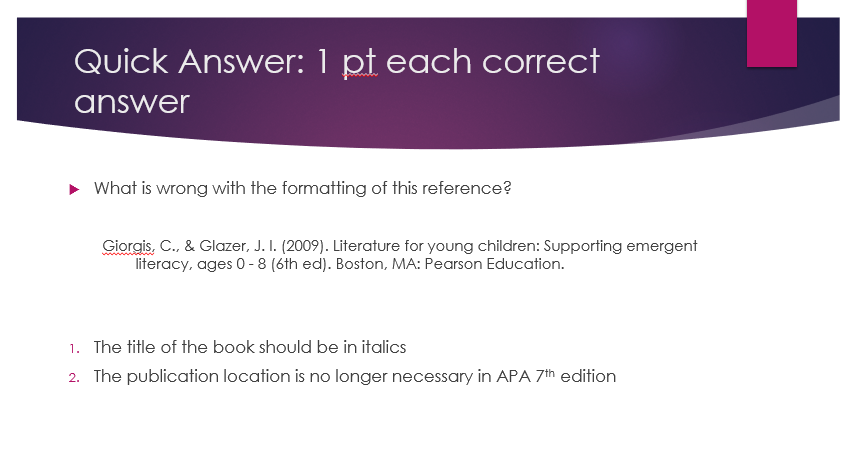
For the On the Board section, questions related to the chosen style are projected via a PowerPoint presentation at the front of the classroom (see Appendix). Some of these questions include a bonus “short answer” component. For bonus questions, teams are allowed to raise hands or “buzz in” to respond. If the first team misses a short answer question, another team may answer and “steal” the point. For On the Board questions, all teams may receive points, including partial credit. Points are awarded based on number of mistakes—5 points for no mistakes, 4 points for a single mistake, etc. In order to maximize the number of questions possible in a class period, I usually allow 1-5 minutes per On the Board question, depending on the complexity of the answer.
Scoring will depend on class and room size. For small classes, I usually circulate the room and discuss each team’s responses and award points. For larger classes or rooms, I project the correct answer on the board and have students self-score–I have found that they are much harder on themselves than I am!
At the end of the class period, each team keeps however many points they have earned as extra credit points for the class, and I award the top team(s) an additional prize (university branded swag, candy, fun pens, etc.).
Reference
Sailer, M., & Homner, L. (2020). The gamification of learning: A meta-analysis. Educational Psychology Review 32(1), 77-112. https://doi.org/10.1007/s10648-019-09498-w.
To cite this article: Sherrill, Lindsey A. (2024). APA Style: The Game. Journal of Public Relations Education, 9(2), 68-74. https://journalofpreducation.com/?p=4064
Editorial Record: This article was originally submitted as an AEJMC Public Relations Division GIFTs paper, with a February 2023 deadline. Top papers were submitted to JPRE June 2023, and accepted for publication at that time. Published January 2024.
Author
Nicole O’Donnell, Ph.D. Assistant Professor Edward R. Murrow College of Communication Washington State University Washington, USA Email: nicole.odonnell@wsu.edu
This assignment serves as an introduction to brand storytelling. Research suggests that storytelling is an essential tool for public relations professionals as stories can entertain, emotionally arouse, inform, and persuade audiences (Kent, 2015; McKee, & Gerace, 2018). However, students’ experiences with storytelling are often personal rather than strategic. For this assignment, I ask students to interview the leader or founder of a local nonprofit organization, business, or school club and use the information they gather to develop a compelling story. Students are instructed that the story should be written in a concise and accessible format that could easily be added to the client’s “about us” website or used in a backgrounder or other client communications.
Rationale
Nonprofit, small, or local organizations often lack the budget for professional communication services. When teaching service-learning classes, my students frequently identify opportunities for our community partners to have an improved web presence and share organizational stories with the public in meaningful and engaging formats. In our media-saturated environment, it is important for a brand to authentically communicate its unique points of difference (Pereira, 2019). Storytelling allows a brand to communicate its mission, vision, and values in ways that resonate with target audiences.
Student Learning Goals:
Develop an understanding of effective brand storytelling and its potential to persuade, inform, entertain, and engage audiences.
Build confidence communicating with professionals in the field and practicing in-depth interview techniques.
Practice summarizing information and writing strategically for a public audience.
Demonstrate the ability to write a compelling brand story based on interview data.
Create a professional work sample that highlights mastery of brand storytelling.
Connection to Public Relations Practice
The USC Annenberg Global Communication Report (2017) identified digital storytelling as one of the most important future skills for marketing and public relations professionals. Furthermore, research suggests that authentic narratives drive brand perceptions and stakeholder engagement (Li & Feng, 2021). As such, this project is a unique way for students to enhance their career readiness and hone essential skills.
This assignment is innovative because it provides students with the opportunity to establish their voices as strategic writers, develop their storytelling skills, and build their confidence speaking with business leaders. Additionally, the work that students produce for this assignment can be shared with the client and can also be added to the student’s professional portfolio.
Assessment:
Students are assessed based on creativity, narrative structure, organization, convention and style, and mechanics. In addition to turning in a written assignment, I ask students to create a five-minute presentation for the class to share their stories. These presentations also include experiential-learning reflection prompts in which students discuss their interview experiences.
Appendix
Assignment Description
Every organization has a story to tell, and learning how to tell that story effectively is an essential skill for public relations professionals. In this assignment, you will interview the leader or founder of a local nonprofit organization, business, or school club and use the information you gather to develop a compelling story. By conducting this interview, you will gain a deeper understanding of the organization’s culture, mission, and values, and learn how to translate that information to a broader public.
Please conduct this interview via phone, Zoom, or in person. The interview should last around 20 minutes. Please ask for the interviewee’s permission to record the interview and use the attached email script and questionnaire as guides. Once you’ve conducted the interview, create a profile of the organization, as if you were writing an “about us” page for its website. Consider what answers stood out to you as interesting or unexpected, and how this story is unique or innovative. Your profile should be well-organized, grammatically correct, and visually engaging, with photos and quotes as appropriate to tell the organization’s story.
Additional Logistics:
Before scheduling your interview, please inform your professor about the individual you intend to interview within a week’s time. This step is crucial to ensure there are no duplicates and to respect the interviewee’s time. If you are contacting a business that you do not have a personal connection with, please consider using a version of the attached email script.
Example Email:
Dear [Business Leader’s Name],
My name is [Your Name], and I am a student at [X university]. I am currently working on a school project that aims to capture the unique stories of local organizations, exploring their history, culture, values, and visions for the future. Your organization has always stood out to me as one that embodies the spirit and innovation of our community.
Given your role in shaping [Organization’s Name], I am interested in conducting a 20-minute phone or in-person interview with you for this assignment. I will use the attached questionnaire as a guide during our conversation. Following the interview, I will craft an “about us” page for a website based on your responses. Your organization can use this if you choose to share your story.
If you’re willing to participate, please let me know a date and time that works best for you in the coming weeks. I will also be notifying my professor about the potential interview to ensure no duplicate efforts from my peers. Any resulting story I write will not be published or shared publicly without your explicit consent. Additionally, once the story is written, I will share a copy with you.
Thank you for considering this request. Your insights and experiences would be invaluable to my project and my understanding of the work [Organization’s Name] is doing.
Interview Script:
Thank you for taking the time to speak with me today. I’m excited to learn more about your organization and its history. Before we begin, I just wanted to confirm, is it okay if I record our conversation so that I can refer back to it later? Thanks again for meeting with me. Could you please introduce yourself and tell me a bit about your role within the organization?
History
Can you tell me about how you first became involved with the organization?
Do you know where your organization’s name came from? Is there a story there?
What was the organization’s first product or service?
What inspired the founders to start the organization?
What gaps or needs in the market did they seek to address?
From your perspective, how has the organization changed over time, and what events have shaped its development?
Values
Can you describe the organization’s culture and working environment?
What values or guiding principles have been important to the organization, and how have these been reflected in its actions and decisions?
Are there any traditions or rituals that the organization holds dear?
How does the organization view its relationship with its customers?
Challenges & Accomplishments
What have been some of the biggest challenges the organization has faced, and how were they overcome?
Were there any pivotal moments or turning points in the organization’s history?
What has been the organization’s proudest achievement to date?
How has the organization contributed to the broader community and industry?
Future Aspirations
Where do you see the organization in the next 10 years?
What are the organization’s current goals, and how are these being pursued?
What long-term impact does the organization hope to have on its industry or the world?
What do you hope the future will hold for the organization?
Thank the interviewee for meeting with you and provide them with follow-up information.
References
Kent, M. L. (2015). The power of storytelling in public relations: Introducing the 20 master plots. Public Relations Review, 41(4), 480-489. https://doi.org/10.1016/j.pubrev.2015.05.011
Li, X. L., & Feng, J. (2021). Empowerment or disempowerment: Exploring stakeholder engagement in nation branding through a mixed method approach to social network analysis. Public Relations Review, 47(3), 102024. https://doi.org/10.1016/j.pubrev.2021.102024
McKee, R., & Gerace, T. (2018). Storynomics: Story-driven marketing in the post-advertising world. Hachette UK.
Pereira, G. (2019). Brand storytelling: A three-dimensional perspective. Journal of Brand Strategy, 8(2), 146-159. chrome-extension://efaidnbmnnnibpcajpcglclefindmkaj/https://www.henrystewartpublications.com/sites/default/files/JBS8.2BrandstorytellingAthreedimensionalperspective.pdf
To cite this article: O’Donnell, Nicole. (2024). Mastering the Art of Brand Story Telling. Journal of Public Relations Education, 9(2), 83-90. https://journalofpreducation.com/?p=4034
Editorial Record: This article was originally submitted as an AEJMC Public Relations Division GIFTs paper, with a February 2023 deadline. Top papers were submitted to JPRE June 2023, and accepted for publication at that time. Published January 2024.
Author
Erika J. Schneider, Ph.D. Assistant Professor, Public Relations S.I. Newhouse School of Public Communications Syracuse University New York, USA Email: eschne03@syr.edu
Overview of the Assignment, Including the Rationale
The adoption of artificial intelligence has changed the public relations practice. AI is a technical development that has been praised in PR for its functionality and efficiency, such as by allowing professionals to automate and perform mundane tasks (e.g., Panda et al., 2019). Considering the projected growth in the employment of PR specialists, which is predicted to be 8% from 2021 to 2031, it is critical for PR educators to prepare students for the needs of the profession (U.S. Bureau of Labor Statistics; 2023). Krishna et al.’s (2020) survey of PR professionals found that senior managers, who may have more insight into the profession, considered new technology like AI to be more important for incoming communicators to have skills or expertise in, relative to middle managers. More recently, AI systems, such as OpenAI’s ChatGPT, Google’s BERT, and Microsoft’s Bing Chat, have advanced ways that professionals develop content (Larkin, 2023), although with limitations (OpenAI, 2023a). In preparing students for the profession, this activity encourages the discussion of the benefits and limitations of AI in PR writing.
In this exercise, students are asked to discuss the utility of artificial intelligence in public relations and evaluate an AI-assisted news release. Begin with a demonstration of how AI follows instructions in a prompt by inputting the following prompt in an AI system, such as chat.openai.com: “Who are the most successful PR professionals in history?” When providing this prompt in ChatGPT in February 2023, the following names were listed: Edward Bernays, Ivy Lee, Daniel J. Edelman, Betsy Plank, and Harold Burson (OpenAI, 2023b). Outputs vary each time the same question is asked. Share the results of the output with students and discuss who is represented and omitted on the list. If there are concerns regarding a lack of inclusive results, such as in the case where the output is dominated by a specific demographic group, there is an opportunity to discuss how the platforms reproduce bias while limiting the visibility and recognition of underrepresented communities.
After discussing representation, enter the following prompt: “Write a news release in AP style.” Ask students to evaluate the AI-assisted news release based on the quality of the content and structure (Ashcroft, 1994), and AP style (AP Stylebook, 2022). Appendix A provides an evaluation tool that has been adapted to the context of this activity. When providing this prompt in ChatGPT in February 2023 (Figure 1), the output did not adhere to AP style and the content and structure of the news release did not meet Ashcroft’s (1994) guidelines; however, outputs vary each time the prompt is entered. After students have an opportunity to evaluate the release, invite them to share observations, corrections, and recommendations. In addition to practicing copy editing, students develop a deeper understanding of how to incorporate AI tools in PR, question potentially problematic repeated bias, and consider the importance of PR professionals’ intervention to address outputs from machine-based systems.
Figure 1. Example of an AI-assisted news release from ChatGPT (OpenAI, 2023c).
Connection to Public Relations Practice and/or Theory
There are risks and benefits to public relations professionals embracing the diffusion of AI technologies. While the benefits include efficiency in automating tasks, the risks, such as concerns regarding privacy and inaccuracies, and long-term societal impacts of AI are less understood (Wilson & Van Der Velden, 2022). Within PR research, the ethical implications of AI’s disruption in PR practices have been considered, such as transparency in AI-assisted communication (e.g., Bourne, 2019).
As tools are adopted into PR practices, there is value in exposing students to relevant tools and skill sets. This in-class exercise applied ChatGPT, but other AI systems may be utilized in this activity. Machine learning and AI platforms and services evolve with new technologies, access, and user preferences. Although the interface may vary, the foundational concepts are applicable across technologies and the understanding of functions is transferable.
Student Learning Goals
1. Understand the benefits and assumptions of AI-assisted communication.
2. Demonstrate knowledge of the principles of PR writing in AI-assisted communication.
Evidence of Learning Outcomes/Assessment
This in-class activity appeals to students in PR courses. Applying this technology in classrooms has been found to motivate and engage students, which is a driver of learning (Haggerty & Davis, 2019). Per feedback on this assignment, students were excited to gain experience with AI and appreciated the assessment of best practices of PR writing. Generally, the students shared that they were familiar with AI but had not questioned or evaluated AI responses to PR writing prompts prior to this assignment, which changed their perspective of its utility. When asked to share their observations and recommendations, students gained confidence in their writing and critical thinking skills. When students discussed deficiencies in the AI-assisted news release, they also recognized the importance of gaining PR expertise to navigate future technological developments.
The Associated Press. (2022). The AP Stylebook: 56th edition. The Associated Press.
Bourne, C. (2019). AI cheerleaders: Public relations, neoliberalism and artificial intelligence. Public Relations Inquiry, 8(2), 109-125. https://doi.org/10.1177/2046147X19835250
Haggerty, R., & Davis, L. E. (2019, July 11). Can chatbots teach copy editing? A comparison of student reporters’ copy editing performance when using a chatbot style guide and a traditional stylebook [Research paper]. World Journalism Education Congress 2019, Paris. http://www.wjec.paris/wp-content/uploads/2020/05/WJEC_proceedings_V2_Final.pdf
OpenAI. (2023b, February 12). [ChatGPT response to a prompt about the most successful PR professionals in history.] https://chat.openai.com/
Panda, G., Upadhyay, A. K., & Khandelwal, K. (2019). Artificial intelligence: A strategic disruption in public relations. Journal of Creative Communications, 14(3). https://doi.org/10.1177/0973258619866585.
Evaluate AP style using the AP Stylebook (2023), and the content and structure of the news release using Ashcroft’s (1994) adapted guidelines. The guideline for evaluating the news release is in the right column, and students may provide evaluations of the guideline to be discussed in the right column.
Guideline
Student Evaluation
Use of AP style
Is the release clearly headed with “Press Release” or “News Release” in large, bold letters?
Does the release display the name of the organization?
Does the release display an address for the organization?
Does the release display information to contact the organization?
Does the release contain an embargo or date of release?
Does the release contain a bolded headline that could catch the eye of an editor? Is it written in present tense, not too gimmicky or puzzling, and indicate the nature of the story in as interesting a way as possible?
Does the opening paragraph include information on the what, the who, the where, the why and the when, in such a way as to make as much impact as possible?
Does the release tell the facts and put them in descending order of importance?
Does the release contain a quotation that provides additional interest and is it given by someone who has authority to speak on the matter?
Does the release contain no more than three quotes?
Does the release contain vigorous language to convey vitality?
Is the end of the release recognized by the word “ENDS” or another indication (e.g., ###)?
To cite this article: Schneider, Erika J. (2024). Challenging AI in the PR Classroom. Journal of Public Relations Education, 9(2), 60-67. https://journalofpreducation.com/?p=4052
Editorial Record: Submitted November 9, 2022. Revised April 27, 2023. Revised June 20, 2023. Accepted June 27, 2023. Published January 2024.
Authors
Heather Riddell, Ph.D. Assistant Professor Department of Communication University of West Florida Florida, USA Email: hriddell@uwf.edu
Amanda Bradshaw, Ph.D. Assistant Professor School of Journalism and New Media University of Mississippi Mississippi, USA Email: asbrads1@olemiss.edu
Abstract
Technology advances in society demand progressive course development from higher education institutions. This study aimed to assess the effectiveness of a new social media course based on PR pedagogy and Dewey’s theory of experience to determine if it adds to the knowledge of communication and responds to the digitally converged public relations industry. The course utilized the pragmatic approach to increase student knowledge in the areas of self, authenticity, privacy, professional use, and relationships on social media. Pre- and post-course surveys tracked the development of learning outcomes. The findings show that critical pedagogy and Dewey’s integration of experience are starting points for designing courses where students have extensive familiarity with the subject matter. This approach to course design moves social media out of the role of a tool to emphasize the full impact of social media and the digital PR industry on students’ personal and professional lives and on relationship-building efforts between brands and their key publics.
Keywords: public relations curriculum, social media, integrated marketing communication, digital media, social media pedagogy
Social media is part of daily life and society and, as a result, has become an in-demand industry with economic impact, particularly in public relations, a strategic communication process where organizations strive to “build mutually beneficial relationships” with their key publics (Kelleher, 2017, p.4). As noted by leading researchers, “There is a growing need to provide dedicated academic instruction designed to prepare graduates for careers in which they will use social media strategically” (Freberg & Kim, 2018, p. 380). Communication and business departments have taken on the challenge of educating students on the demands of the integrated marketing communication industry (Rehman et al., 2022). This is particularly critical as two of the professional core competencies outlined by the Accrediting Council on Education in Journalism and Mass Communications (ACEJMC) include teaching students to “1) present images and information effectively and creatively, using appropriate tools and technologies, 2) write correctly and clearly in forms and styles appropriate for the communications professions, audiences and purposes they serve” (ACEJMC, 2022). An online analysis of 75 university master’s programs in public relations (PR), followed by surveys and in-depth interviews with working PR professionals, revealed that participants want a curriculum “that includes the newest digital tools and strategies for communication careers…” including storytelling, digital and social media strategy, and measuring communication effectiveness (O’Neil & Lambaise, 2016, p. 13).
However, while most universities have PR, advertising, and marketing courses, they may only incorporate social media as a module or a valuable tool. As noted by Luttrell et al. (2021), there is a need for more courses, trainings, and certificate programs that focus on digital and social media in the changing media environment. However, an exploratory literature search on teaching social media in PR revealed very little about training students for this new industry segment from a PR perspective (Hamadi et al., 2021). The desire to build an academically rigorous and industry-centered course drives this research and establishes the goal of testing a pedagogic model frequently used in communication departments to determine the effectiveness of a digital PR course focusing on foundational social media topics.
Department Needs
The new course need originated from a department with strong public relations and advertising programs. These programs are housed in a department of communication focused on PR, journalism, public speaking, and broadcasting. The course was requested to meet local employer needs and update the curriculum with industry-desired skill sets (ACEJMC, 2022; Freberg & Kim, 2018). This update in the curriculum also addresses the issues noted in the Commission on Public Relations Education (CPRE) Spotlight Series on technology trends in PR, specifically, proficiency in new tools and platforms, data usage, and new uses for platforms (Kinsky, 2022). These areas were addressed in the course, emphasizing professional and business purposes modules and the privacy modules that discuss metadata usage.
Although the course needed to focus on training students in technology, it needed to do so but still advance the goals of the existing PR curriculum. The frame of the course was focused on achieving PR objectives like building relationships and maintaining a positive reputation instead of business or marketing goals, as covered by the curriculum in the marketing department.
Course Design
The new course design needed flexibility for essential topics to be discussed face-to-face in a weekly module structure. Each week focused on crucial communication, PR, and social psychology theories, like social comparison theory, diffusion of innovation, and parasocial interaction, that are exhibited on social media both professionally and personally to help students see the connection between theory and online human communication (Humphreys, 2015; Luttrell et al., 2021; Zhong, 2021). In addition to the assigned readings from strategic communication texts, student assignments included writing weekly online discussions based on prompts in the learning management system (LMS). The prompts asked for student opinions and experiences to leverage the critical pedagogy framework (Talib, 2018). As commonly seen in PR communication courses, writing assignments allow class discussions to synthesize student responses with their experiences or perceptions about the theories. Finally, modules on social media platform functionality were incorporated to underscore digital literacy and reputation management elements of social media and PR. These modules emphasized the form and function of how each of the major platforms (Facebook, Instagram, Twitter, etc.) could be used professionally.
The initial course conceptualization included essential theories, skill development, and basic functional know-how. A review of essential topics showed that a foundational social media course should touch on concepts similar to traditional public relations and interpersonal courses: a sense of self, relationships, conflict, culture, and professional/leadership communication. Utilizing those course structures, plus the key topics from digital PR courses together, created a framework for the new course. The established interpersonal communication and PR pedagogy allowed social media topics and platform functionality to be discussed along with aspects of relationships, reputation, and conflict while integrating the digital lives that Gen Z college students lead, connecting the basis of the course to Dewey’s concept of pragmatism by using experience in the classroom (Bull et al., 2008; Dewey, 1938; Langmia et al., 2013; Talib, 2018).
The next step in the course design was reviewing what classes existed and the focus of those courses. Approximately 25 publicly available social media syllabi from 2017 to 2021 from state and regional universities were reviewed for approach, key topics, learning objectives, and course descriptions. Many of the courses used social media as a business tool or for digital journalism. As a result, there was still the question of how to design a social media course that provides academic rigor, ties in key concepts of PR, and provides a foundation for understanding the social media industry.
The new course was also intended to be the first in a series of courses in a certificate aimed at training students in PR and developing social media skills. Although this course addresses the needs of the developing social media industry, the course and certificate needed to be grounded in concepts essential to producing PR students equipped with the training to become more than technicians of the technology but to embrace professionalism and relationship-building qualities of PR in a digital space (Brunner, 2022).
Literature Review
Current Social Media Pedagogy
There are three distinct ways social media pedagogy has been discussed in higher education and PR programs. The first way was as a tool to help understand traditional communication concepts or as a learning management asset (Hamadi et al., 2021; Talib, 2018), such as interpersonal communication in digital spaces. The second was a media or digital literacy component in introductory speech courses emphasizing functionality or knowing how to use it for academic research (Reyna et al., 2018; Stewart, 2015). The third way was integrating a section about social media to help understand the relationship between human communication and technology in any given subject, like mass media (Reyna et al., 2018). Although beneficial teaching approaches, these structures did not address the course design needed for a foundational social media course in an integrated PR program that would serve as an entry point in the curriculum for earning a digital communication certificate. Due to the gap in current academic scholarship related to the design of a social media in PR course, the course for this study was developed and tested.
Course Design Challenges
The approach to building this course is different from the three approaches to social media pedagogy mentioned above because social media was addressed as more than functional know-how or a lens into the digital world, but as a course that specifically trained students to design and create messages that achieve purposeful digital PR goals. The variables found in current research connect to three main clusters of learning: 1) knowledge of self, 2) knowledge of the industry, and 3) knowledge of others (Perloff, 2014; Rewaria, 2021; Schlosser, 2020; Talib, 2018).
The new social media course integrated traditional communication and pedagogical theories like Uses and Gratifications Theory (UGT), Bloom’s Taxonomy, and Dewey’s concept of pragmatism, along with essential topics in social media communication and PR (Perloff, 2014; Rewaria, 2021; Schlosser, 2020; Talib, 2018). The initial process of designing a social media course posed a challenge based on the prevailing view of social media in higher education as an integrative tool instead of a developing industry and potential academic program (Hamadi et al., 2021; Stewart, 2015; Talib, 2018). Additionally, as public relations courses already existed, there needed to be a clear academic framework for the course learning objectives, such as Bloom’s Taxonomy, which is a classification system developed to define and distinguish levels of human cognition (Bloom et al., 1956). The revised version of Bloom’s Taxonomy includes, from highest to lowest: remembering, understanding, applying, evaluating, and creating. (Anderson & Krathwohl, 2001). As many schools have embraced Bloom’s Taxonomy when writing student learning objectives, the concepts became foundational in creating the new course that could be a part of the PR specialization and a starting point for a new certificate. In addition to balancing industry needs and academic requirements, the new course’s design needed to acknowledge that students were coming in with prior knowledge of the subject matter, as many have multiple social media accounts and have actively engaged on social media for several years across many platforms. Dewey’s concept of pragmatism connects the concepts of learning and experience and, thus, was also the starting place for course design, as student experience needed to be woven into the course assignments.
Uses and Gratifications Theory
Uses and gratifications theory (UGT) (Katz et al. 1973-1974) is a subtradition of media effects research (McQuail, 1994) and examines the needs, motivations, and gratifications of media users. In the most recent applications as a framework, UGT applies to computer-mediated communication (CMC) environments, including social media, where users are more empowered since switching between mediums that provide similar services or content is relatively easy. Four extracted gratification factors related to social media pedagogy in previous research include trust, profit, learning, and social, all of which have high validity and reliability, along with an expressed desire among learners for co-content creation in social media course design, which is consistent with UGT, “which considers users to be active decision-makers who seek, use, and apply media for their own purposes” (Wu & Song, 2019, p. 2). Therefore, in pedagogical research and teaching related to social media and digital media strategy, professors must understand the needs of learners so that they can use social media correctly and more effectively achieve their teaching goals (Wu & Song, 2019).
Generation Z (Gen Z), born between approximately 1997-2010, is considered the first truly digital native generation, as members of this cohort have always known a digital world with social media (Francis & Hoefel, 2018; Mosca et al., 2019). Gen Z may be technology dependent and proficient, but these students still need instruction on solving problems and utilizing technology to create and implement effective PR strategies (Gaidhani et al., 2019; Mosca et al., 2019).
Social Media Usage
In relation to UGT, social media usage was addressed to determine whether requiring students to have a social media account and to communicate on a social media platform for course credit results in positive interactions. Previous research suggests that requiring any social media usage could backfire and result in a bad experience impacting future usage (Stewart, 2015). Additionally, many of the platforms used by instructors are not used heavily by students (Brubaker et al., 2021). Since this course was designed with the intent of being the first of three courses (followed by content creation and social media management), the class discussions integrated previously observed behaviors instead of creating forced, academically composed responses that are typically observed on required course discussion boards in an LMS (Booth, 2012; Liu, 2019; Suler, 2004). To avoid inauthentic social media participation, assignment prompts were created and housed in the LMS as journal entries instead of forcing students to communicate with each other via social media. Keeping the discussions on the LMS helped students think critically about their previous experiences before class, as the LMS would prompt them about the upcoming deadline while also preparing students to engage in class discussions face-to-face. For example, the prompt on the LMS on social capital was multifaceted and stated, “Explain social capital in your own words. How do you think social media influencers create or build their social capital? Provide an example of positive and negative use of social capital.” The prompts would be integrated into class time to allow students to add their own experiences to the discussion. This understanding led to using (UGT) as a framework for applying critical pedagogy and the pragmatist approach. This is seen in many traditional public speaking or interpersonal communication courses where personal experience is leveraged in the classroom to achieve specific learning objectives.
Dewey and Experience
Dewey’s (1938) theory of experience in education was used as a guide as social media is participatory, and students’ experiences provide a basis of understanding that must be acknowledged before introducing new concepts. Students come in with varying levels of expertise since social media is so accessible. Dewey (1938) highlighted experiences as a starting point for education and saw education as a partner with experience (Berding, 1997; Hutchinson, 2015). The emphasis on experience or doing versus discussion or memorization is the heart of pragmatism in education. The concepts of pragmatism as a teaching approach can be summed up with “four critical John Dewey concepts: (1) democratic society, (2) progressive and authentic education, (3) reflection, and (4) freedom and guided discovery” (Milunic, 2013, p. 27). This course touches on all four elements with a focus on concepts two through four, as students leaving the course must know how to communicate effectively on social media and be willing to learn from past experiences.
Many pedagogical approaches are based on giving students new experiences to help them learn and shape their view of a subject. Dewey’s (1938) theory of experience was chosen as it involves the use of history as “a potent agent in appreciation of the living present” (Seaman, 2019, p. 23). This course needed to use past experiences as a springboard for social media analysis. The reshaping of critical topics through the discussion of experiences is what could make a PR social media course the most effective. Experiences on various platforms (e.g., Facebook, Twitter, LinkedIn, YouTube) are also a point of emphasis as social media are continually changing, and the trends are constantly shifting. Through exploration and experience, students can see the trends that make specific posts popular and understand, holistically, social media’s effects on industry and society beyond the technical aspects of how to craft an engaging TikTok (or current trend).
Combining a critical theory and a pragmatist approach with Bloom’s Taxonomy creates a course that challenges students to go beyond their current views of social media and begin to see its impact on society, identity, culture, and communication (Talib, 2018).
Assessment and Assignments
In choosing course assignments to achieve the learning objectives, written assignments in the LMS were paired with in-class discussions to provide opportunities that allow for higher levels of Bloom’s Taxonomy to be mastered. Bloom’s Taxonomy starts with the foundational remember and understand objectives in the classroom and moves to more challenging levels of applying concepts and evaluating quality (Bloom et al., 1956). The final levels of the Taxonomy are evaluate and create, which utilize the foundational levels to achieve complex learning outcomes ((Bloom et al., 1956; Krathwohl & Anderson, 2009). Although the course had the digital topic of social media, written assignments were not abandoned as a pedagogical tool. Bean (2011) focuses on incorporating writing into any course, regardless of the discipline. Integrating PR and social media observations into written assignments provides a clear opportunity to assess and ensure students achieve the learning objectives (Bean, 2011; Li & Guo, 2015). “Good writing assignments evoke a high level of critical thinking, help students wrestle productively with a course’s big questions, and teach disciplinary ways of seeing, knowing, and doing” (Bean, 2011, p. 2). The emphasis on writing helps establish the link between the assignment and learning objectives for the course and prompts critical thinking that sparks the reshaping of experience and understanding of the communication that occurs on social media.
Additionally, cognitive learning is observed through assignment grades; the knowledge of self was harder to assess, so this study utilized a pre-and post-course survey as seen in other pedagogical research to track the development of specific learning outcomes (Broeckelman-Post et al., 2021; Hufford, 2010; Kirkwood et al., 2011). This study aimed to assess the effectiveness of the new social media course based on PR pedagogy and Dewey’s theory of experience to determine if it adds to the knowledge of communication and responds to the digitally converged communication industry.
PR/Social Media Industry
The digital PR and social media industry is more complicated than it initially appears, making teaching digital PR and social media challenging as it requires knowledge of a digitally converged industry (Luttrell et al., 2021; Sutherland & Ho, 2017). Developing a topic-specific series of courses that emphasizes human behavior, relationship management, content creation, and account management can address the gap in current higher education training and career emphasis. The burden lies on departments and faculty to be up-to-date on industry expectations and needs (Freberg & Kim, 2018; Luttrell et al., 2021). “As social media becomes an essential part of work and life in general, some argue that social media should be considered a core twenty-first-century skill” (Sutherland & Ho, 2017, p. 262). An intimate knowledge of the industry and theory is needed to create effective courses. Social media should not just be taught as a tool but with a holistic approach to address the new professional and personal communication implications. One guiding principle of social media is that it is ever-changing; thus, emphasizing digital or social media literacy can be limiting as new platforms, trends, and communication styles are developed.
Foundational Knowledge
Digital literacy, communication, and creating effective marketing content tend to be the most apparent skills for social media courses. The psychology behind human behavior and PR tactics are also foundational to social media effectiveness. The relevant psychology topics significant for social media, include identity/self, authenticity, and in PR, relationships, and reputation management. For Gen Z, these topics are essential, as they seek out truth and authenticity in dialogue and emphasize being yourself in interpersonal communication situations (Abreu, 2019; Francis & Hoefel, 2018; Witt & Baird, 2018). Body image, catfishing, finstas (fake Instagram accounts), misinformation, and relationship problems are commonly cited issues with social media (Jones, 2013; Perloff, 2014; Williams & Ricciardelli, 2014). Understanding these issues and concepts is essential in the industry to avoid writing content that can be seen as tone-deaf or lacking in effectiveness. The viral nature of positive and negative content adds new challenges as the factors that create a crisis situation also include social media crises. Connecting with key audiences becomes a primary focus that requires understanding social media’s pros and cons. This discussion leads to the following hypotheses:
H1: Students’ understanding of self and social media will increase after taking this course.
H2: Students’ understanding of the authenticity of communication (in relationships) on social media will increase after taking this course.
Additionally, privacy is a major topic on social media and impacts how people use the platforms. Data breaches and scandals like Cambridge Analytica impact users’ platform choices (Kennedy, 2018; Lawler et al., 2018). Privacy issues are a concern, as seen with the focus on TikTok and WeChat, China-owned companies, and their use of metadata (Vigdor, 2020). Privacy and data usage should become a foundational social media concept to be taught to all students, especially those planning to enter the industry (Talib, 2018). This analysis leads to the third hypothesis:
H3: Students’ understanding of privacy issues on social media will increase after taking this course.
The final important area to highlight is the differences between personal and professional usage. This concept includes using PR to brand a company and communicate based on that brand voice. As seen in Dewey’s pragmatist approach, there should be an emphasis on experience, but experience, in this case, can be utilized to establish the quality of messages posted on social media. The industry sets its trends and standards for what is acceptable. Personal experiences on social media provide a framework for students but also challenge students to consider the business situations that motivate professional social media usage (Schroth, 2019). For instance, in a study exploring the impacts of social media content posted by Chief Executive Officers (CEOs) on Twitter, Yue et al. (2019) found that high personal disclosure by CEOs did not increase the perceived likability or competence of the CEO, but CEOs’ professional disclosures effectively achieved high levels of perceived relationship investment from publics. Therefore, understanding the differences in personal and professional platform usage and how to use social media platforms to communicate most effectively in a business setting and to build relationships between organizations and their key publics is a skill that needs to be developed, especially as students come in with knowledge of how to produce personal content on social media (Fratti, 2013; Schroth, 2019). This discussion leads to the final hypothesis:
H4: Students’ view that social media is useful for professional and business purposes will increase after taking the course.
Methodology
Procedures
IRB approval was obtained for this study and covered the administration of pre-and post-class surveys hosted on Qualtrics. Participants for this study were students enrolled in the sections of a special topic course, fundamentals of social media, at a university in the Southeastern United States during the spring, summer, and fall semesters of 2019. Although the lead researcher/instructor of record recruited students from the courses and encouraged participation, students were not required to complete these tasks and were not penalized if they chose not to participate. To reduce the variance of this study, all three selected sections met in a face-to-face format that integrated substantial LMS components. The class met twice per week and was taught by the same instructor. In all sections, students completed written social media communication assignments based on the same prompts that were uniquely written by the instructor but based on topics found in Humphrey’s (2015) text on social media theory. For example, the module on identity asked, “How does social media impact the way we see ourselves and others? How can we prevent FOMO (fear of missing out) or the negative impacts on our self-esteem?” The module on digital media laws asked, “What suggestions do you have for helping our laws catch up to our social media use?” During the semesters, all students willingly completed pre-and post-course surveys to measure the variables of self, authenticity, privacy, professional use, and relationships (Perloff, 2014; Rewaria, 2021; Schlosser, 2020; Talib, 2018; Xu et al., 2012).
Participants
A total of 75 participants were included in this study. Of the participants who responded to the pre-and post-course survey, 69.3% (N = 52) were female, 29.4% (N = 22) were male, and 1.3% (N = 1) identified as other. For ethnicity, 64% (N = 48) identified themselves as white or Caucasian, 16% (N = 12) as Black or African American, 5% (N = 4) as Hispanic or Latino, 4% (N = 3) Asian and 11% (N = 8) indicated other. When it came to age demographics, 92% (N = 69) of respondents were between 19-24 years old, 5% (N = 4) were 25-34 years old, 1.3% (N = 1) were between 45-53 years old, and 1.3% (N = 1) preferred not to respond. The participants were predominantly communication majors (97%, N = 73) since the course is an upper-level communication course with specific prerequisites like basic communication and introduction to PR.
Measures
The lead researcher/instructor of record asked students to take a 30-question online Qualtrics survey within the first week of the semester and then asked them to retake the same survey before finals week. The surveys were open for seven days at the beginning and end of the semester. The survey took students around 30 minutes to complete. The survey content focused on social media habits, usage, favorite platforms, and PR concepts, including stakeholder identification (Rawlins, 2006), branding (Mikáčováa & Gavlakov, 2014), professional message usage (Doyle, 2008), and users’ overall comfort level on social media. Some of the questions included assessments like “I am confident posting and commenting on social media” and “I know how to use social media for business purposes,” with a five-point Likert scale ranging from definitely disagree to agree completely. No open-ended questions were used for this study. As mentioned above, the survey was designed to glean insight into the following five variables: self, authenticity, relationships, privacy, and professional use.
Each of the five variables was addressed in two different questions to help verify student understanding and opinions and were operationalized as follows, using a 5-point Likert agreement scale in each case:
Self – is the perception of one’s qualities and characteristics. This variable was measured with questions such as, “Who I am on social media accurately reflects who I am.”
Social media understanding – is digital literacy regarding the features and functions of each social media platform. This variable was investigated with questions like “I am confident posting and commenting on social media.”
Authenticity – the truthful representation of a person’s identity and personality. This was also an attention-check variable with questions on the authenticity of Relationships and self. One question asked, “Which social media platform do you believe is best for building relationships?”
Privacy – from the Merriam-Webster dictionary (2021), “freedom from unauthorized intrusion” on social media. This variable was measured with do you agree with questions with statements like “Social media platforms protect my privacy and data.”
Professional and business purpose– considers that the motivation for communication is based on a business situation and seeks to meet an organization’s goal or PR message. This variable included an attention check by asking two questions regarding professional and business communication by changing up the terminology to determine if the Likert response had remained consistent. Additional questions asked which platforms were best for specific business functions and also asked about the confidence level of communicating a business purpose on certain social media platforms.
Results
A within-subjects MANOVA was conducted to determine whether students in class improved their understanding of key social media topics. A MANOVA was chosen based on the number of dependent variables and the ability to simultaneously conduct multiple analyses on the dependent variables. Additionally, a MANOVA limits the possibility of a null hypothesis by reducing a joint error rate with multiple dependent variables. To reduce familywise inflation of alpha, a MANOVA with three independent variables (course, gender, age) and five dependent variables (self, authenticity, relationships, privacy, and professional use) was conducted. Box’s M test for the equality of covariance matrices was not significant at the .001 level [F (36, 4130.64) = 1.07, p >.001], so Wilk’s Lambda values were used. Multivariate tests showed significant main effects for time [F (4, 68) = 1.25, p = .00, ηp2 = .07, power = 1.00], which indicates an increase in the dependent variables from the beginning to the end of the semester. The test also showed significant results of time by gender [F (4, 68) = 4.78, p = .03, ηp2 = .07,
power = .6], and time by age [F (4, 68) = 1.11, p = .001, ηp2 = .06, power = .3]. No other main effects or interaction effects were significant.
Tests of between-subjects effects further confirmed that there were significant differences for privacy, [F (4, 68) = 3.69, p = .05, ηp2 = .05] and relationship, [F (4, 68) = 3.72, p = .05, ηp2 = .07] and professional use [F (1, 71) = 1.20, p = .007, ηp2 = .08]. Indicating an increase in students’ understanding of knowledge of industry and knowledge of others, supporting hypotheses 3 and 4.
However, there were no significant main effects for self [F (1, 71) = 264.78, p = .09, ηp2 = 1.15, power = .1] and authenticity [F (1, 3) = 1.87, p = .23, ηp2 = .097, power = .4] which does not support hypotheses 1 and 2. Pairwise comparisons indicate that students did not change the way they view their identity of self and how they communicate on social media from the beginning (M= 1.88) to the end (M= 1.91) of the semester. Means and standard deviations are shown in Table 1.
Table 1 Means and Standard Deviations
M
SD
.
Self and social media confidence
1.91
.29
Authenticity Relationships
3.653.39
.76.93
Privacy
2.19
.93
Professional and business purpose
6.24
1.35
Discussion
This research builds knowledge of how to teach an industry-appropriate PR social media course in a higher education setting. This project approached the topic uniquely as it combined traditional communication pedagogy concepts with industry needs and societal concerns. Creating a course to set the foundation for additional classes was challenging as multiple pedagogical techniques could be utilized, especially considering the digital options. This research used a longitudinal approach to gauge the learning objectives and level of knowledge increase in students who took this foundational course.
In the first hypothesis, H1: Students’ confidence in using social media will increase after taking this course; the concept of confidence and self while using social media was not supported. These variables explored how identity and image discussions affect how students feel about themselves while communicating in digital spaces. The lack of a significant finding indicates a needed shift in how a sense of self is discussed and further insight into the relationship between identity and self in online spaces. Additionally, the characteristics of Gen Z must be factored in as the students are digital natives and have grown up knowing who they are in digital spaces and do not think about themselves in fragmented identities of real and online/digital self (Francis & Hoefel, 2018). Due to growing up as digital natives, comfortable with social media, the students had high skill levels coming into class and were already comfortable navigating social media platforms and posting their own content. Future research may further explore concepts like fear of missing out (FOMO) and how social media content can influence mental health and individuals’ sense of identity, self, and ultimately their behaviors both on and offline.
This outcome and hypothesis related to hypothesis two, H2: Students’ understanding of the authenticity of communication (in relationships) on social media will increase after taking this course was partially supported with a significant result in relationships and an insignificant result in authenticity, which was surprising. Self and authenticity in digital spaces are important aspects of Gen Z as this generation is comfortable with technology and cannot remember a time without cell phones (Francis & Hoefel, 2018). Gen Z can easily communicate via technology and values individuality but despises labels, which is a motivating factor for communication. The emphasis on authenticity and knowing the self are defining characteristics of the generation (Francis & Hoefel, 2018). After further review of existing literature, this is a trend and supports that there would be no significant effect noted. For instance, the BeReal app was the 5th most popular social media app in February 2022, three years after the course in the current study concluded (Sklencar, 2022, Oct). This app, which is based on the premise of authenticity and the fact that users are asked to post a real photo of themselves, with no filters, one time per day at random, has gained exponential popularity in a short time– jumping from 7.67 million downloads in April 2022 to 53 million worldwide downloads in October 2022, or 315%, according to Apptopia (Davis, 2022). The popularity of such apps like BeReal among Gen Z is notable, and platforms that emphasize authenticity should continue to be explored in courses such as this as students learn to professionally leverage unfiltered, authentic content strategically, on a holistic level, from a PR standpoint. Integrating the topics that discuss self and authenticity is still valuable to include in critical pedagogy and a holistic approach to the subject, especially as the emphasis on digital relationships from a PR perspective adds additional complexity.
The next area that this research examined was privacy. H3: Students’ understanding of the privacy issues on social media will increase after taking this course. This topic’s significant results show that including discussions on metadata, terms of the agreement, and analyzing previous data breach scandals show students that a click is not just a click and that it means something in the digital world. Integrating readings, discussions, and written prompts allows students to engage with a topic they have observed but do not know much about. Using critical pedagogy and Dewey’s pragmatism is especially poignant in discussing privacy, as students can see the impact but do not understand the full implication. As noted by other authors, “Students have told me that they have noticed ads specifically tailored to them based on their previous page views, searches, clicks, purchases, and chats; however, most students underestimate the scale and detail of behavioral tracking, misunderstand its basic processes (particularly the role of third-party trackers), and lack an appreciation for its social consequences (ideological or otherwise)” (Corrigan, 2015, p. 49). Emphasizing restraint and transparency in the discussions can help students enter the workforce in a big data era.
Finally, the last hypothesis, H4: Students’ view that social media is useful for professional and business purposes will increase after taking the course, had significant results indicating the need to train students with professional communication skill sets in digital spaces. The increase in knowledge will help students take their experiences as consumers and use them to become the producers of information and connect with appropriate influencers. Students are familiar with the platforms from the consumer side but need additional courses on being a producer and receiver of professionally oriented social media information. Integrated marketing communication proficiency includes being familiar with and adeptly employing content designed to generate engagement and a two-way dialogue related to personal and organizational branding, building mutually beneficial relationships with key publics in PR, promoting products and services in advertising, creating effective customer service and hospitality practices, and applying marketing concepts (Yue et al., 2021). Learning such skills will benefit students as they shift their view of social media platforms from leisure, entertainment, and escape to places where they can generate strategically designed business messages to consumers. UGT is particularly salient here and an area for future research in social media scholarship and pedagogy. As noted above, there are four extracted gratification factors related to social media pedagogy, and trust and profit connect to PR concepts of creating mutually beneficial relationships, especially those that benefit an organization (Wu & Song, 2019). Using UGT as a framework for future research on PR conducted on social media allows for emphasis on how practitioners use social media and how users/publics use it to connect to organizations.
Course Design Outcomes
Considering the findings of this study, the course was altered following the study to allow for additional time in the syllabus to discuss professional communication needs and how the inclusion of brand identity and personality is essential for connecting with key publics and users. As a foundational course, opportunities to build clear professional communication expectations can be carried forward into the following PR and digital courses. Another key aspect of this concept is tailoring the message to the platform and the publics found in each space. As noted above, students are not on every platform and, as a result, will need to be shown and instructed on how to communicate with publics varying in demographics and psychographics.
Another change is based on the privacy finding that necessitates additional time and assignment opportunities to allow for data security concerns, as seen with social media data collection, to be discussed. Dewey’s theory of experience and UGT come into discussions regarding data privacy as students have stories from their own usage. For example, an additional assignment tests priming from social media ads with an experiment to test a common fear that phones are listening to us. As marketing and advertisers use tailored ads to create relevant ad experiences, it is beneficial to students personally and professionally to be aware of current privacy and data collection methods.
Finally, as some topics need more time, others have less time allotted on the syllabus. Using the findings, platform demos were reduced and combined. It was also found that assigning students to prepare a demo of the platforms focused the demo on the usage aspects they did not already know instead. This shift increased the value of the demos and took less time, freeing up class time for other significant topics.
Limitations and Future Research
This research’s limitations include the sample size and population, as this research was conducted at a regional comprehensive public university in the southeastern United States. A larger sample from a more urban setting should be conducted to assess this course design’s effectiveness in increasing student knowledge about social media. Although the five variables in this study were insightful, studying additional areas relevant to social media, like cyberbullying, extortion, and advertising/influencer messaging, would provide more insight into how students learn and react to communicating and building relationships online. A limitation of this study was the way the variable of relationships was presented from a personal frame in connection to authenticity, and an additional study should focus on the singular variable of the professional PR relationships. Additional research should also be conducted on additional social media courses like content development and social media management to determine if students are gaining the correct digital PR skill sets from academic institutions.
Conclusion
This study emphasizes the pedagogical implications of a constantly changing digital industry. As PR continues to utilize digital tools and the industry becomes more converged, higher education courses need to be responsive to the changes in technology and how those changes impact PR tools, conversations, and skill sets. The findings show that critical pedagogy and Dewey’s integration of experience through pragmatism are starting points for designing courses where students have extensive familiarity with the subject matter. Coursework should integrate Dewey’s theory of experience and the high levels of Bloom’s Taxonomy of analyzing, evaluating, and creating to account for the knowledge students have of social media while providing industry insight while achieving the course’s learning objectives (Bloom et al., 1956).
The approach to a foundational course found in this study is not a singular solution but can be a starting place for departments looking to create additional courses and programs that combine theory from multiple areas while also emphasizing the significance of social media communication in PR (Hamadi et al., 2021). This research is novel in that it grounds social media coursework in theory instead of emphasizing social media’s marketing or business purposes. Additionally, it moves social media out of the role of a tool to aid learning experiences and emphasizes the full impact of social media as an industry on students’ personal and professional lives (Freberg & Kim, 2018).
Integrating experiences through a pragmatic approach is successful and acknowledges Gen Z students’ existing social media and technology experience (Francis & Hoefel, 2018; Mosca et al., 2019). Although this generation is comfortable with technology personally, comfort does not always mean knowledge and proficiency professionally. Social media courses that provide theoretical foundations should be created to help students reshape their current understanding of human behavior and communication as they enter the digitally converged PR and social media industry (Luttrell et al., 2021; Rehman et al., 2022).
References
Abreu, R. (2019). Social media micro-influencer marketing and purchasing intention of millennials: The role of perceived authenticity and trust [Doctoral dissertation, Dublin Business School]. Dublin Business School. https://esource.dbs.ie/handle/10788/3674
Anderson, L. W. and Krathwohl, D. R., et al. (Eds..) (2001) A taxonomy for learning, teaching, and assessing: A revision of Bloom’s taxonomy of educational objectives. Allyn & Bacon.
Bean, J. C. (2011). Engaging ideas: The professor’s guide to integrating writing, critical thinking, and active learning in the classroom. John Wiley & Sons.
Bloom, B. S., Engelhart, M. D., Furst, E. J., Hill, W. H., & Krathwohl, D. R. (1956). Taxonomy of educational objectives: The classification of educational goals. Handbook 1: Cognitive domain (pp. 201-207). New York: McKay.
Booth, M. (2012). Boundaries and student self-disclosure in authentic, integrated learning activities and assignments. New Directions for Teaching and Learning, 2012(131), 5–14. https://doi.org/10.1002/tl.20023
Broeckelman-Post, M. A., Malterud, A., Arciero, A., & Hyatt Hawkins, K. E. (2020). Can course format drive learning? Face-to-face and lecture-lab models of the fundamentals of communication course. Basic Communication Course Annual, 32(1), 79-105. https://ecommons.udayton.edu/bcca/vol32/iss1/7
Brunner, B. R. (2022). Tracing the evolution of public relations education. In D. Pompper, K.R. Place & C. K. Weaver (Ed.) The Routledge Companion to Public Relations (pp. 201-212). Routledge.
Bull, G., Thompson, A., Searson, M., Garofalo, J., Park, J., Young, C., & Lee, J. (2008). Connecting informal and formal learning experiences in the age of participatory media. Contemporary issues in technology and teacher education, 8(2), 100–107. https://www.learntechlib.org/primary/p/29328/
Corrigan, T. F. (2015). 3 Who’s Tracking Me? In J. Frechette & R. Williams (Ed.) Media Education for a Digital Generation, (pp. 46-60). Routledge.
Freberg, K., & Kim, C. M. (2018). Social media education: Industry leader recommendations for curriculum and faculty competencies. Journalism & Mass Communication Educator, 73(4), 379-391. https://doi.org/10.1177%2F1077695817725414
Gaidhani, S., Arora, L., & Sharma, B. K. (2019). Understanding the attitude of generation Z towards the workplace. International Journal of Management, Technology and Engineering, 9(1), 2804-2812. DOI:16.10089.IJMTE.2019.V9I01.18.27732
Hamadi, M., El-Den, J., Narumon Sriratanaviriyakul, C., & Azam, S. (2021). A social media adoption framework as pedagogical instruments in higher education classrooms. E-Learning and Digital Media, 18(1), 55-85. https://doi.org/10.1177/2042753020950869
Hufford, J. R. (2010). What are they learning? Pre-and post-assessment surveys for LIBR 1100, introduction to library research. College & Research Libraries, 71(2), 139–158. https://doi.org/10.5860/0710139
Humphreys, A. (2015). Social media: Enduring principles. Oxford University Press.
Hutchinson, D. A. (2015). Coming to understand experience: Dewey’s theory of experience and narrative inquiry. Journal of Thought, 49(3-4), 3-17 https://www.jstor.org/stable/jthought.49.3-4.3
Jones, K. (2013). #zerotolerance# KeepingupwiththeTimes: How federal zero tolerance policies failed to promote educational success, deter juvenile legal consequences, and confront new social media concerns in public schools. Journal of Law & Education, 42(4), 739-749. https://heinonline.org/HOL/P?h=hein.journals/jle42&i=757.
Katz, E., Blumler, J. G., & Gurevitch, M. (1973-1974). Uses and gratifications research. Public Opinion Quarterly, 37(4), 509–523. https://doi.org/10.1086/268109
Kelleher, T. (2017). Public relations. (2nd ed.). Oxford University Press.
Kennedy, H. (2018, March 29). How people feel about what companies do with their data is just as important as what they know about it. Impact of Social Sciences Blog. http://eprints.lse.ac.uk/89031/
Kirkwood, J., Gutgold, N. D., & Manley, D. (2011). Hello world, it’s me: Bringing the basic speech communication course into the digital age. Communication Teacher, 25(3), 150–153. https://doi.org/10.1080/17404622.2011.579905
Krathwohl, D. R., & Anderson, L. W. (2009). A taxonomy for learning, teaching, and assessing: A revision of Bloom’s taxonomy of educational objectives. Longman Publishing.
Langmia, K., Tyree, T. C., O’Brien, P., & Sturgis, I. (Eds.). (2013). Social media: Pedagogy and practice. University Press of America.
Lawler, M., Morris, A. D., Sullivan, R., Birney, E., Middleton, A., Makaroff, L., . . . Eggermont, A. (2018). A roadmap for restoring trust in Big Data. The Lancet Oncology, 19(8), 1014–1015. https://doi.org/10.1016/S1470-2045(18)30425-X
Li, L., & Guo, R. (2015). A student-centered guest lecturing: A constructivism approach to promote student engagement. Journal of Instructional Pedagogies, 15(2015),1-7. https://digitalcommons.kennesaw.edu/facpubs/3608
Liu, Y. (2019). Using reflections and questioning to engage and challenge online graduate learners in education. Research and Practices in Technology Enhanced Learning14(1), 1-10. https://doi.org/10.1186/s41039-019-0098-z
Luttrell, R., Wallace, A., McCollough, C., & Lee, J. (2021). Public relations curriculum: A systematic examination of curricular offerings in social media, digital media, and analytics in accredited programs. Journal of Public Relations Education, 7(2), 7. https://aejmc.us/jpre/wp-content/uploads/sites/25/2021/09/JPRE-7.2.pdf#page=7
McQuail, D. (1994). The rise of media of mass communication. In D. McQuail (Ed.), Mass communication theory: An introduction (pp. 1–29). Sage.
Mikáčová, L., & Gavlaková, P. (2014). The role of public relations in branding. Procedia-Social and Behavioral Sciences, 110, 832-840. https://doi.org/10.1016/j.sbspro.2013.12.928
Milunic, M. (2013). The experience of learning to teach: A study of a traditional and an alternative teacher certification route in relation to John Dewey’s theory of experience and education. (Publication No. 3575127.) [Doctoral Dissertation, Saint Joseph’s University]. ProQuest Dissertations Publishing.
Mosca, J. B., Curtis, K. P., & Savoth, P. G. (2019). New approaches to learning for Generation Z. The Journal of Business Diversity, 19(3), 66–74. https://doi.org/10.33423/jbd.v19i3.2214
Perloff, R. M. (2014). Social media effects on young women’s body image concerns: Theoretical perspectives and an agenda for research. Sex Roles, 71(11-12), 363-377. https://doi.org/10.1007/s11199-014-0384-6
Reyna, J., Hanham, J., & Meier, P. C. (2018). A framework for digital media literacies for teaching and learning in higher education. E-learning and Digital Media, 15(4), 176-190. https://doi.org/10.1177/2042753018784952
Rehman, S. U., Gulzar, R., & Aslam, W. (2022). Developing the integrated marketing communication (IMC) through social media (SM): The modern marketing communication approach. SAGE Open. 12(2), 1-23. https://doi.org/10.1177/21582440221099936
Seaman, J. (2019). Restoring culture and history in outdoor education research: Dewey’s theory of experience as a methodology. Journal of Outdoor Recreation, Education, and Leadership, 11(4). https://doi.org/10.18666/JOREL-2019-V11-I4-9582
Sklencar, A. (2022, October 10) 20 BeReal stats you need to know. Online Optimism. onlineoptimism.com/blog/bereal-stats-app-figures-data-be-real-numbers-to-know/
Stewart, O. G. (2015). A critical review of the literature of social media’s affordances in the classroom. E-Learning and Digital Media, 12(5-6), 481-501 https://doi.org/10.1177/2042753016672895
Suler, J. (2004). In class and online: Using discussion boards in teaching. CyberPsychology & Behavior, 7(4), 395–401. https://doi.org/10.1089/cpb.2004.7.395
Sutherland, K., & Ho, S. (2017). Undergraduate perceptions of social media proficiency and graduate employability. Higher Education, Skills and Work-Based Learning. 7(3), 261-274. https://doi.org/10.1108/HESWBL-02-2017-0018
Talib, S. (2018). Social media pedagogy: Applying an interdisciplinary approach to teach multimodal critical digital literacy. E-learning and Digital Media, 15(2), 55–66. https://doi.org/10.1177/2042753018756904
Xu, C.; Ryan, S.; Prybutok, V.R. & Wen, C. (2012). It is not for fun: An examination of social network site usage. Information & Management. 49. 210–217. https://doi.org/10.1016/j.im.2012.05.001
Williams, R. J., & Ricciardelli, L. A. (2014). Social media and body image concerns: Further considerations and broader perspectives. Sex Roles, 71(11-12), 389-392. https://doi.org/10.1007/s11199-014-0429-x
Witt, G. L., & Baird, D. E. (2018). The Gen Z Frequency: How brands tune in and build credibility. Kogan Page Publishers.
Wu, Y., & Song, D. (2019). Gratifications for socialmedia use in entrepreneurship courses: Learners’ perspective. Frontiers in Psychology, 10 (2019), 1-12. https://doi.org/10.3389/fpsyg.2019.01270
Yue, C. A., Chung, Y. J., Kelleher, T., Bradshaw, A. S., & Ferguson, M. A. (2021). How CEO social media disclosure and gender affect perceived CEO attributes, relationship investment, and engagement intention. Journalism & Mass Communication Quarterly, 98(4), 1157–1180. https://doi.org/10.1177/1077699020943521
Zhong, B. (2021). Social media communication: Trends and theories. Wiley Blackwell.
To cite this article: Riddell, H. and Bradshaw, A. (2024). Dewey and Social Media: Using a Pragmatic Approach to Designing a Foundational Public Relations Social Media Communication Course. Journal of Public Relations Education, 9(2), 2-37. https://journalofpreducation.com/?p=3991
This article was originally submitted as an AEJMC Public Relations Division GIFTs paper, with a February 2023 deadline. Top papers were submitted to JPRE June 2023, and accepted for publication at that time. Published January 2024.
Authors
Kelly Bruhn, Ph.D., APR Associate Dean School of Journalism and Mass Communication Drake University Iowa, USA Email: kelly.bruhn@drake.edu
Amy McCoy Asst. Professor of Strategic Political Communication and Public Relations School of Journalism and Mass Communication Drake University Iowa, USA Email: amy.mccoy@drake.edu
Chris Snider Associate Professor School of Journalism and Mass Communication Drake University Iowa, USA Email: chris.snider@drake.edu
Ryan Stoldt, Ph.D. Assistant Professor School of Journalism and Mass Communication Drake University Iowa, USA Email: ryan.stoldt@drake.edu
Jennifer Wilson Fisher-Stelter Chair of Magazine and Brand Media Studies School of Journalism and Mass Communication Drake University Iowa, USA Email: jennifer.wilson@drake.edu
Overview of the Assignment, Including the Rationale
Using ChatGPT, a chatbot developed by OpenAI and launched in November 2022, a group of faculty members facilitated an in-class exercise across six different courses that included administering a pre-test to assess students’ confidence in evaluating and testing new technology tools and innovations, reviewing current news featuring the tool, previewing a creative execution using the tool, and evaluating the tool individually. The session ended with a post-test to reassess the same factors listed above, as well as a discussion of the ethical considerations communicators must make when evaluating new digital technologies and innovations. This exercise reinforced the important role communicators have in critically evaluating new tools—a practice they must master for long-term success.
Student Learning Goals and Connection to Public Relations Practice And/Or Theory
Aligning with the college’s core values, this in-class exercise is designed to help students “apply tools and technologies appropriate for the communication professions in which they work,” “demonstrate an understanding of professional ethical principles and work ethically in pursuit of truth, accuracy, fairness and diversity,” “take ownership of their own academic experience,” and “cope and thrive in the workplace.” This exercise aligns with the Commission on Public Relations Education’s call for embedding ethics within coursework while also improving communicators’ abilities “to move, be nimble and adaptable” (Prsaweb, 2023 p. 11).
Evidence of Learning Outcomes/Assessment
Ninety-four students participated in this exercise across six courses. Some key findings:
When comparing pre- and post-test responses, average scores improved slightly across each factor. Student averages were lowest when answering “I consider myself an innovator.” (Pre-test: 6.3 avg; Post-Test 6.4 avg.). Every other question averaged between 7.1 and 7.8.
Scores varied widely when students were asked if they keep up with tech trends, with responses ranging from 2 to 10.
When asked to share their ethical considerations regarding digital technology, student responses on the post-tests were much more robust than their initial responses. Each class enjoyed a rich discussion of ethics to conclude the exercise, and topics ranged from copyright and attribution concerns to misinformation dissemination to worry about future job security.
Using a scale of 1 (Completely Disagree) to 10 (Completely Agree), students responded with an average of 4 for their proposed use of ChatGPT or other AI tools at work vs. an average of 2.9 using those same tools at school.
Two students’ post-test responses summarized many students’ feelings by saying, “AI can be used as a tool, but not as a replacement,” and “I think AI will be a useful tool for many professions. Right now, AI can’t replicate the complexity of the human mind, but it is a useful tool for idea generation.”
Show NBC Nightly News Report from 12/22/22 on artificial intelligence (Appendix D)
Show ChatGPT in Action via the Ryan Reynolds Mint Mobile ad (Appendix D)
Share highlights from NPR’s story featuring a student who created a ChatGPT detector (Appendix D)
Showcase the ChatGPT toll at https://openai.com/blog/chatgpt – Important Note: Load it up early to avoid ‘at capacity’ messages. Ask students to think about how they might use this tool in their careers. Here are two examples:
“Please write five headlines for an animal rescue organization.”
“Write a one-page press release announcing a new event design to raise money to help children with cancer.”
Give students 5-10 minutes to play with the tool. Again, ask them to think about how they might use this tool in their careers.
Administer and Collect Post-Tests (Appendix B)
Whole-Class Discussion About Ethics of the Tool
You may also consider administering an additional two-question, anonymous survey asking if they plan to use the tool at work or at school. (Appendix C)
I feel confident in my ability to develop content for online audiences.
Completely Completely
Agree Disagree
10 9 8 7 6 5 4 3 2 1
I enjoy testing new digital tools.
Completely Completely
Agree Disagree
10 9 8 7 6 5 4 3 2 1
I consider myself an innovator.
Completely Completely
Agree Disagree
10 9 8 7 6 5 4 3 2 1
I am comfortable evaluating new digital tools or technologies.
Completely Completely
Agree Disagree
10 9 8 7 6 5 4 3 2 1
Please indicate on the line below the percentage of time each day you estimate you will use each of the following in your future career. For example, you may answer 10% on one tool and 55% on another tool. If you don’t anticipate using the tool, you may answer 0%. Please share additional technology/digital tools you anticipate using and the associated percentages in the “Other” option below.
_______ Social Media
_______ Search Engine Optimization
_______ Data Analysis Tools
_______ Mobile App Creation/Maintenance
_______ Augmented Reality/Virtual Reality
_______ Artificial Intelligence
_______ Other (please specify) _________________________________________
Please share your ethical considerations regarding digital technology.
Appendix C
Sample Anonymous Post-Module Survey
I plan to use ChatGPT or other AI tools to complete future assignments at work.
Completely Completely
Agree Disagree
10 9 8 7 6 5 4 3 2 1
I plan to use ChatGPT or other AI tools to complete future assignments at school.
Completely Completely
Agree Disagree
10 9 8 7 6 5 4 3 2 1
Anything else to add?
Appendix D – Resource List for Instructor Background
To cite this article: Bruhn, K., McCoy, A., Snider, C., Stoldt, R., and Wilson, J. (2024). ChatGPT in the Classroom: Using the Latest Technology to Explore Innovation and Ethics. Journal of Public Relations Education, 9(2), 75-82. https://journalofpreducation.com/?p=4014
Editorial Record: Original draft submitted June 6, 2020. Revisions submitted October 30, 2020. Manuscript accepted for publication December 19, 2020. First published online September 2021.
Authors
Regina Luttrell, Ph.D. Associate Professor Public Relations & Social Media Syracuse University Syracuse, NY Email: rmluttre@syr.edu
Adrienne A. Wallace, Ph.D Associate Professor School of Communications Grand Valley State University Allendale, MI Email: wallacad@gvsu.edu
Jiyoung Lee, Ph.D. Assistant Professor Journalism & Creative Media The University of Alabama Tuscaloosa, AL Email: jlee284@ua.edu
Abstract
As public relations (PR) students prepare for life in the professional world, the educational experiences inside of the college classroom should reflect transformations within the profession. To that end, this study included a systematic analysis of all domestic Accrediting Council on Education in Journalism and Mass Communications (ACEJMC) and Certification in Education for Public Relations (CEPR) accredited graduate and undergraduate PR programs to understand how social media, digital media, and analytics courses have been incorporated into PR program curricula. The data was collected over the summer months of 2019 and the fall semester of 2019. The results included 94 schools that offer PR as a major. This comprehensive study was meant to provide a thorough examination of the current state of curricular offerings related to emerging technologies.
Keywords: public relations curriculum, social media curriculum, analytics, digital media, public relations education
As the lines between public relations (PR), advertising, and marketing continue to blur, further advances in data, analytics, digital media, and artificial intelligence (AI) lend an even greater influence on where the industry is heading. Platforms such as Instagram, Facebook, YouTube, Twitter, and mediums like podcasts, have promoted new forms of participation for users by allowing them to generate messages as a creator and take collective actions, which relate to interactional empowerment (Shirky, 2011). To meet these industry demands, educators within higher education have developed digital and social media-related courses particularly for students majoring in PR (Ewing et al., 2018); however, the degree to which PR education is responding to shifts within digital spaces remains understudied.
This research, conducted over the summer months of 2019 and fall academic semester of 2019, carried out content analysis of all domestic Accrediting Council on Education in Journalism and Mass Communications (ACEJMC) and Certification in Education for Public Relations (CEPR) accredited graduate and undergraduate PR programs to understand how and where social media, digital media, and analytics courses have been incorporated into the PR curricula (Appendix A-C). Through manual coding, quantitative and qualitative analyses, this research provides a comprehensive look at the state of social and emerging media course offerings within accredited PR programs. Findings reveal gaps and opportunities that exist in social and emerging media education, and to what extent, the proliferation of these areas of study was being taught within the 21st Century PR curriculum in the United States. This research provides a snapshot of the classes offered and their course descriptions at ACEJMC and CEPR universities in the U.S during a specified time.
On the heels of the development of digital media tools including social media, educators seem to recognize the importance of adopting digital and social media. In Auxier’s (2020) study of 39 educators, when asked how important teaching their students content related to social media and tools associated with social media, 77.5% of them responded “very important” or “important,” with only 17.5% responded only ‘slightly to moderately important.’ Research has shown that teaching new media tools bring multiple benefits to students, including increased interactions with educators and peers, convenience of learning (Chugh & Ruhi, 2018), and developing their technical skills further (Larrondo Ureta & Peña Fernández, 2017), which can be useful in professional fields afterwards. They discovered that students who learned multimedia and social media tools developed not only teamwork or skills to interact with audiences but also technical skills including search engine optimization skills.
Despite these recent findings on the importance of teaching social media-related tools, the degree to which PR education is responding to these shifts within higher education remains unclear.
Review of the Literature: Evolution of Digital in Public Relations
Scholars offer some perspective on the importance of digital technology to PR over the course of the past decade, and how it relates to principles of best practice. Macnamara (2010) initially found support for the idea that practitioners were effectively exploiting social media for interactive, two-way communication by maintaining dialogic models of PR (Kent & Taylor, 2002), the Excellence Theory of PR (Grunig & Grunig, 1992), and Gini Dietrich’s PESO model (2014). Further, Moreno et al. (2015) investigated the relationship between practitioners’ personal and professional use of social media. Results show that practitioners with a high level of personal usage of social media give more importance to social media channels, influence of social media on internal and external stakeholders and relevance of key gatekeepers and stakeholders along with a better self-estimation of competencies.
Over the past decade, scholars examined this relationship through a variety of PR contexts, including corporate social responsibility (Cho et al., 2017), crisis communication (Romenti et al., 2014), nonprofit communication and fundraising (Carboni & Maxwell, 2015), government and political communication (DePaula & Dincelli, 2018), stakeholder dialogue (Elving & May Postma, 2017), cultivating credibility (Kim & Brown, 2015), relationship cultivation (Pang et al., 2018), strategic public identification and engagement (Watkins, 2017), and social presence (Men et al., 2018).
Sommerfeldt and Yang (2018) summarized the twenty-year body of study on digital communication in PR as “an indispensable part of public relations practice. It is clear from the state of research and practice in public relations that the question is no longer if, but how to best use digital communication technologies to build relationships with publics” (p. 60). The emphasis on social and digital media in terms of two-way communication is not new. A meta- analysis of the 20-year body of research on communication in social and digital media used in PR, of the 79 studies identified as relevant, 83% were concentrated on content analysis, 75% discussed practical applications, and only 25% presented theoretical implications (Wirtz & Zimbres, 2018). Examining big data on digital spaces has been found as a crucial strategy for researchers to explore dialogic communication, as Sommerfeldt and Yang (2018) identified the next opportunities for research in big data, where analytics have opened the door for new research opportunities in the discipline and to better understand the impact of this approach to social and digital media in PR.
However, the growth of social media use in practice has yet to be successfully integrated into the PR curriculum. Auger and Cho (2016) conducted a comprehensive analysis of PR curricula and concluded that the current PR course offerings were not only meeting industry needs, but also providing foundational knowledge in ethics, law, research, and globalization in course content. Unfortunately, educators fell short on social and new media, which students articulated.
The gap of integrating social and digital media into PR education is a critical need to be addressed, partly because of emerging challenges that social and digital media pose to communication practitioners. The long-standing problems of fake news (Nelson & Taneja, 2018), bots (Woolley & Howard, 2016), and racial tensions on social media with brands (Novak & Richmond, 2019) are all areas in which PR educators are needing to address in the classroom. In a digital media ecology, scholars and practitioners need to prevent the amplification of these problems in those being trained to enter the industry. This makes having students understand and address the issues using what they have learned from classes a stated priority in ACEJMC and CEPR standards. Therefore, it is important for educators to develop students’ understanding of challenging issues in a digital media environment.
Current Status of Public Relations Curriculum
Scholars, educators, and practitioners set out to identify courses and competencies essential to graduates entering the modern workplace. According to the Commission on Public Relations Omnibus Survey findings (Commission on Public Relations Education [CPRE], 2018), educators reported that current required courses linked to technology were graphic design and social media, followed by courses that involve video production, digital media, and visual communication. Educators and practitioners both cited technology-based topics such as social media, analytics, web coding, and graphic design as important competencies for the workplace. Also noted was the importance of data literacy to modern practice for graduates. They need to not only know how to find available data but also to be able to pull out valuable information from it in order to make smarter decisions.
The integration of digital technology is evident in the entry-level positions. Brunner et al. (2018) found that writing remains a priority for employers, but a healthy emphasis on social media writing (47%) and blogs (27%) were present in the postings. Social media was a clear priority for employers, with a general mention of social media aptitude (32%), or references to specific platforms like Facebook (14%), Twitter (12%), LinkedIn (7%), YouTube (7%), Instagram (2%), and Pinterest (2%). The authors’ findings suggest the importance of integrating social and digital media into production and writing courses in the PR curriculum. With some perspective on the growing emphasis on digital in PR work, the authors focus on a more effective definition for the digital PR curricula.
Research highlights the importance of teaching emerging communication platforms to students in PR degree programs, as technology does not ‘stand still’ (CPRE, 2018). Digital tools are changing the way we communicate and the way we understand current issues, so that the need for understanding technologies should be at the forefront in PR education. Duhé (2015) argues three pillars of PR education in the future: (a) fast-forward thinking, (b) interdisciplinary learning, and (c) analytical prowess. Of these, analytical prowess particularly refers to data gathering and analysis, which requires students to find, summarize and present information in an effective manner (Duhé, 2015). However, a disconnection between educators and practitioners in PR in terms of what should be developed further in the academic curriculum of PR programs persists.
In addressing the issue that faces PR education, Wright and Flynn (2017) provide two reasons behind the disconnection between PR practitioners and educators: PR programs are mostly subsets of other disciplines (e.g., journalism, mass communication, business, etc.), and interaction between educators and practitioners on curriculum development is rare. Such limitations in current PR programs relate to the lack of developing technology-based courses that connect PR curriculum to recent trends in technology. To follow the current trends of media, courses not related to technology should also include activities connecting technology trends (CPRE, 2018).
Previous Research Regarding Digital PR Curriculum
The literature illustrates that scholars are considering the impact of digital technology on the traditional teaching and learning of PR, as well as effective professional preparation of students in the classroom by consulting with industry professionals. Neill and Schauster (2015) made use of in-depth interviews with executives in advertising and PR agencies in the United States to identify the core competencies needed to have successful careers in the new media landscape. The findings indicated that while writing and presentation skills remain essential, employers identified math and data analysis commonly associated with social media listening and analytics as critical for new employees.
Indeed, digital technologies are now seen as the norm for PR practitioners, as supported by Wolf and Archer’s (2018) research, which illustrates that the dialogic qualities of digital and social tools do not only support traditional PR capabilities but have become an essential part of it. Related, Fang et al. (2019) note that the continuing technological development of the advertising and PR (PR) industry and increasing transfer of marketing expenditures from traditional channels to emerging digital media have placed a heavy burden on advertising and PR education to train aspiring practitioners for strategic use of these technologies. Through a content analysis of 99 universities with advertising and PR programs, Fang et al. (2019) found that nearly a quarter of advertising and PR courses taught digital media, placing a greater emphasis on skills courses.
To specifically understand how educators were integrating social and digital media analytics into PR courses, Ewing et al. (2018) examined pedagogical practices documented on students’ learning outcomes on course syllabi and Twitter chats between educators and industry professionals. Their findings suggest that developing concepts and skills, measuring results, contextualizing data, and learning how to use tools to engage in social listening were priorities in practice. Furthermore, some integration of industry-standard measurement platforms was needed. In 28% of the courses studied integrated social media platforms for course communication and activities as well as professional certifications programs.
Focusing more on social media education, other scholars interviewed 20 industry professionals to seek industry insights on the topics that should be covered in PR courses including social media, as well as what roles educators need to serve in these courses (Freberg & Kim, 2018). Industry professionals identified multi-platform content creation, marketing and PR principles, writing, analytics, and crisis communication. Importantly, the roles highlighted by industry professionals were liaisons between the academy and industry, experienced content builders, and role-models and mentors. Overall, these findings, which evaluated how social and digital media were reflected in PR-focused disciplines, altogether suggest that a gap between industry expectations and the academic courses should be mended.
In addition to examining professional skill-building, other scholars tested the effectiveness of social and digital media integration in PR classroom activities that reinforce theory and principles of practice. Fraustino et al. (2015) discovered that integrating case study discussions could create conditions for an experiential learning process, which allowed students to exchange theories and concepts with other peers. While another study was extended to examine teleworking and cross-institutional conditions (Madden et al., 2016).
However, integrating digital media presents challenges, although it is considered an essential adaptation in the teaching and learning of PR. Novakovich et al. (2017) found that introducing professional social media skills into the curriculum provoked a significant amount of resistance on the part of learners. Students lack a sense of agency on social networks and required guidance when articulating modes of online authenticity. The scholars also found an alarming gap between students’ everyday practices on social networks and professional practice. Research documents that other factors should be considered such as perceived usefulness, ease of use in platforms, or desirability to use platforms, to encourage students for their continued use of digital media for learning (Dalvi-Esfahani et al., 2020). With a discussion of studies exploring the digital PR curricula, in general, the focus shifts to digital PR as a required course in the curriculum.
Social Media, Digital Media, and Analytics as a Required Course in PR Curriculum
Grounded by the uses and gratifications theory (Katz & Blumler, 1974), college students frequently use digital and social media for diverse purposes, including interacting with friends or family or entertainment (Ezumah, 2013). Although students today are considered ‘digital natives,’ those born after the 1980s and exposed to these digital technologies at a very early stage of their lives (Prensky, 2001), more courses about digital media should be developed, as self-assessed digital skill does not always indicate that students have much expertise in digital media used in the professional world (Kumar et al., 2019). For example, a multigroup analysis demonstrated a clear pattern of differences in effect exists between digital natives and digital immigrants (individuals born before the 1980s), or before the existence of digital technology (Prensky, 2001) with respect to the sequential belief updating mechanism with regard to adoption and use of digital tools (Kesharwani, 2020). While the results are relatively stable over time, digital natives desire instructor guidance to build their familiarity with new technology. This improved pedagogy would further enhance their compatibility with the system being used by PR practitioners, as frequently, digital media are used for getting to know audiences and building relationships in a community through social media encourage meaningful and critical discussions (Moody, 2010). By learning how to use social media effectively, students can become active participants in conversations (Quinn-Allan, 2010). Students can understand the role of digital media platforms in connecting a community, and how they can use the medium to facilitate conversations with audiences, which are essential skills of communication professionals.
Additionally, incorporating social media into PR programs can enhance students’ abilities to produce and share information efficiently (Locker & Kienzler, 2013), which is related to data literacy or “knowing how to identify, collect, organize, analyze, summarize, and prioritize data,” and “how to develop hypotheses, identify problems, interpret the data, and determine, plan, implement, and monitor courses of action” (Mandinach & Gummer, 2013, p. 30). Given its importance, Ridsdale et al. (2015) offer several tips for data literacy education, including teaching the benefits of using data, relating workshops with practical experiences, module- and project-based learning that has real-world applicability, and using real-world data that can spur students’ interests. Relating digital PR courses to the real-world can make students prepare to be a communication expert. This educational approach should go beyond allowing students to become familiar with using technologies.
On the basis of the stated literature, the researchers posed the following research questions:
RQ1: Where are social media, digital media, and analytics taught in accredited PR programs?
RQ2: How are social media, digital media, and analytics being taught in accredited PR programs?
Methodology
The research team used a systematic approach to investigate where in the PR curricula social media, analytics, and digital media courses were being incorporated into undergraduate and graduate programs across domestically located ACEJMC and CEPR accredited schools (Appendix A). This research was not meant to compare courses offered at ACEJMC accredited universities to those offered at CEPR accredited schools; rather, it provides a descriptive compilation of curricular offerings. Using predetermined categories, the research team collected data from fully accredited ACEJMC and fully accredited CEPR universities. A comparable approach to the quantitative research that Langan et al. (2019) conducted was applied wherein they investigated AACSB accredited programs within marketing curricula to understand how digital marketing courses were incorporated into domestic marketing programs.
The entirety of the data collected represents programs that offer either bachelor’s or graduate degrees in PR, advertising, strategic communication, integrated marketing communication (IMC) and journalism. Of the institutions contributing to the dataset, a subset (n=94) of accredited institutions was examined; of which 74 held ACEJMC accreditation (Appendix B), 69 CEPR accreditation (Appendix C), and 52 holding both ACEJMC/CEPR accreditations (Appendix A). Figure 1 highlights this breakdown of program accreditations.
Figure 1
Number of ACEJMC and CEPR Accredited Schools Total
Additionally, of the 94 institutions of interest, each school was more closely examined for degree availability, with programs offering both a bachelor’s and graduate degree in PR being of most interest. Figure 2 highlights eight ACEJMC, 12 CEPR, and a combined 27 ACEJMC/CEPR accredited programs offering a bachelor’s degree in PR, while Figure 3 indicates that there are four ACEJMC, two CEPR, and a combined 17 ACEJMC/CEPR accredited programs offering graduate PR programs.
Figure 2
Accredited Programs Offering Bachelor’s and Master’s Degrees in Public Relations
Data Collection Procedure and Compilation
Qualitative and quantitative research methodologies were used to gather data to address the research questions. During the summer and fall of 2019, members of the research team collected and compiled data from 94 accredited colleges and universities. To ensure the accuracy of the data, specific research criteria were defined, guiding researchers with identifying the desired inputs for the broader dataset. The authors created a subset of the master list of relevant institutions and divided the list equally among members of the research team for the initial data collection, with each subset of data then undergoing a cross-validation from a different researcher for further validation.
Due to the inherent variability of the data of interest between institutions, intercoder reliability is important to ensure interpretation of latent content is consistent between coders. Common discrepancies between researchers and datasets tended to relate to the course naming conventions used by institutions and the associated coding, prompting additional discussions and exploration to determine if the course did, in fact, meet the defined research criteria. As the discrepancies were resolved, a refined search and documentation procedure was developed, allowing the larger list of remaining institutions of interest to be divided among researchers and investigated as part of the final dataset.
Table 1
Available Areas of Specialization Within Accredited Public Relations Programs of Study
To examine data, a thorough content analysis of course descriptions was conducted, which is discussed in detail below.
Data Criterion
Leveraging a thorough review of the literature, the researchers understand how social media, digital media, and analytics have been incorporated into current PR curricula, which informs our data collection and analysis. The research team visited university and college websites pulling information from course catalogs to collect data based on the following variables:
Public Relations Major: We define PR major as any institution that offers a bachelor’s or graduate degree in PR and that follows the accreditation standards for either ACEJMC or CEPR guidelines.
Required Courses: We recorded the names, course numbers, and descriptions of courses dedicated to curricula on social media, analytics, or digital media as requirements to graduate with a PR degree.
Elective Courses: The researchers recorded the names, course numbers, and descriptions of courses on social media, analytics, or digital media as electives offered within PR programs.
Tracks: The researchers recorded the number of institutions that offer a track in social media, analytics, and digital media.
Certificates: The researchers recorded the number of institutions that offer a university accredited certification specializing in social media, analytics, and digital media. Certifications offered through third party organizations such as Hootsuite or Google were not included in this analysis.
Social media courses: The researchers adopted a broad definition of social media as our criterion when analyzing course content as there are multiple definitions available (McIntyre, 2014; Otieno & Matoke, 2014). To that end, social media “are web-based services that allow individuals, communities, and organizations to collaborate, connect, interact, and build community by enabling them to create, co-create, modify, share, and engage with user-generated content that is easily accessible” (McCay-Peet & Quan- Haase, 2017, p. 17). Based on this definition, social media in our analyses includes diverse platforms that feature two-way interactions, such as YouTube, podcasts, Facebook, Twitter, and Instagram.
Digital media courses: Courses that provide an infrastructure and tools used to produce and distribute content via digital channels were defined as digital media (Howard & Parks, 2012).
Content Analysis Method
Using the course descriptions collected, the research team performed content analysis (Berelson, 1952) of the presence of key curricular areas present in the available course descriptions (N=154) to assess what content is delivered as well as how the content is delivered. The researchers adopted content analysis because it offers an objective, systematic manifestation of the content of communication, enabling the research team to explore what is actively present in the courses analyzed within accredited PR programs by facilitating a rich, complex body of data. Krippendorf (1980) maintains that content analysis offers technical sophistication and scientific rigor.
Findings
Based on content analysis, data collected from the aforementioned 94 institutions of interest, having obtained either ACEJMC, CEPR, or both accreditations for their undergraduate and graduate PR programs, a closer examination was completed to understand how social media, analytics, and digital media courses have been incorporated into the PR program curricula. Of the 94 identified schools, 50% (n = 47) offer a bachelor’s degree, 24.5% (n = 23) offer a graduate degree and 17% (n = 16) offer a minor in PR. Of these institutions, we found that only 30 programs (31.9%) require students to take a course specifically related to social media, digital media, or analytics to fulfill either their undergraduate or graduate degree requirements. The remaining 68.1% (n = 64) of institutions did not require a social media, digital media, or analytics course within their PR curricula. Further, 15 of the identified institutions (15.9%) provided an option for students to take at least one social media, digital media, or analytics course as an elective within the curriculum. Of these same schools offering electives, only one program (6%) required a course within these domains, as well as offered an additional elective(s). Stated differently, only about one in three institutions possessing either ACEJMC, CEPR, or both accreditations require a social/digital media or analytics course within their core PR curriculum.
We recognize that programs offering undergraduate, graduate or minors in PR may also provide additional course offerings that are available to students with an interest beyond PR. This study specifically examined PR curricula. As noted earlier, at these 94 institutions of interest, social media, digital media, and analytics may also be available as either a certificate, track, or concentration.
Course Description Analysis
The content analysis of the 154 course descriptions found on university websites through their respective course catalogs demonstrates some intuitive understanding of the progression of the discipline to an integration of strategic communication sub-discipline, and the necessity for integration of technical and strategic aptitude with social media and digital media within the context of theory and principles of best practice. Figure 3 demonstrates a word cloud which is a visual representation of keyword frequency and relevance based on text data (Appendix D) from the course descriptions (Dubinko et al., 2006). The larger and bolder the word appears, the more often it is mentioned within a given text and the more important it is.
Figure 3
Word Cloud Containing Course Titles of the ACEJMC and CEPR Accredited Schools Examine
Implied Presence of Public Relations Models
In reviewing the content in the course descriptions, the integration of core principles of best practice associated with PR models and social media, digital media, and data analytics emerged. Research to maximize the impact of emerging technology saw 20 total references across the body of course descriptions. The strongest concentration of discussion centered around the strategic application of primary and secondary research aimed at understanding targeted digital audiences, as well as the problems and needs of clients, with 12 references across the course descriptions. While research saw a strong presence in the course descriptions, goal and objective setting for social media and digital media was largely absent from the conversation. Terms such as social media, viral campaign, and spreadable media strategy was mentioned 13 times among the course descriptions. Evaluation using data measurement and analysis had a healthy presence in the course description, though not as strong as others in the group associated with PR campaign modeling. As a larger grouping, evaluation was discussed 19 times. Looking at the focus of discussion of evaluation within the course descriptions, 15 focused on the relationship between evaluation and assessment and determining campaign outcomes.
Technician Work Over Managerial Mindset within Digital Media
In reviewing the course descriptions there is heavy emphasis on technical work, with minimal discussion of managerial focus across the social media courses available at accredited programs. An anticipated result is the abundant presence of a myriad social and digital media production skill set references (73) in course descriptions. Included among these references are content creation for social media and multimedia platforms (12), Web design (10), social media practice (9), graphic design (8), digital storytelling (7), search engine optimization including Google certification (5), mobile application design (5), music and audio engineering (5), video production (4), still photography (3), mobile communication (2), online interactive advertisement production (1), computing coding (1), and the use of drones for recording purposes (1). In addition to social media production skills, the researchers found a strong emphasis on writing within the social media course descriptions. Writing for media, news writing, and PR writing were referenced in 10 instances in the course descriptions. Specifically, relevant to strategic social media, audience engagement and interactivity is mentioned in 10 course descriptions. Associated with engagement and interactivity, audience or consumer behavior is discussed in three course descriptions, and user experience is mentioned in two course descriptions. There is clearly an emphasis on skill-building to accommodate one-stop shop work in social and emerging media.
Contemporary and Traditional Conduits for Strategic Communication
There is a strong presence of social and digital media platforms among the course descriptions analyzed. Social media platforms are mentioned in 26 different course descriptions, whether by specific platform or in general. Strategic use of blogs is referenced in three specific course descriptions. Podcasting is referenced in two total courses, and really simple syndication (RSS) feeds are referenced in two course descriptions. AI and virtual reality, emerging platforms in PR and affiliated strategic communication sub fields, are referenced in one course description.
Strategic application of social and digital media platforms is present in 25 total courses. Discussion of strategic use of digital media, social media, new media, transmedia, and multimedia tactics are referenced in 10 total courses. Results revealed that the PESO model (Dietrich, 2014) is becoming a standard element within courses on social and digital media, reflecting its growth as a core component of PR industry practice. Macro-strategic applications of integrated, converged, and multimedia are mentioned in eight total courses. Consideration of the impact of emergent technologies in the discipline are present in 10 total course descriptions. The impact of emerging technology on strategic campaign design and development are present in five total courses. Additionally, the philosophical discussion of technological evolution, dynamism, and innovation is present in five total courses.
Data Analytics, Interpretation, and Visualization
Among the more dominant concepts in the analysis is an emphasis on the value of data analytics, data analysis, leveraging findings to maximum strategic effect, and articulating those findings in a meaningful way to strategic publics, clients, and organizational leadership. Analysis and interpretation are the strongest areas of emphasis, referenced in 32 total course descriptions. Specific concepts of discussion include analysis of data analytics in 16 courses, measurement and analysis of social media in 13 courses, data manipulation and interpretation in two courses, and keyword competitive analysis in one course.
The relationship between analytics and big data was discussed across 25 courses. In addition to the discussion of data analytics in 14 courses mentioned above, specific emphasis on social media analytics is present in 10 courses. Data insights, visualization, and presentation were also present in the review of course descriptions in 23 courses. Data visualization is present in 10 courses; data presentation is present in six courses; social listening, data insights, and Return on Investment are mentioned in one course apiece.
Certificates, Tracks or Concentrations
At the 94 educational institutions examined, social media, analytics, or digital media may also be available as either a university awarded certificate, track, or concentration. The analysis indicates that most schools with PR programs offer certificates (n = 24, 25.5%), concentrations (n = 10, 10.6%), or tracks (n = 13, 13.8%) in social media, analytics, or digital media.
Sociocultural and Professional Impact
Within the analysis of course descriptions, there is a strong presence of the intersection of media, culture, and society. Sociocultural considerations of the impact of emerging social and digital technologies are present in 24 course descriptions. Discussion about various forms of impact on social contexts are discussed in 17 course descriptions. Discussion of intercultural and global influence on strategic social media campaigns are present in three course descriptions.
Discussion of the sociological dimensions of online culture, network communication, online shaming, and the impact of social and digital media on celebrity culture are present in one course description each.
The impact of social media on the news industry, news consumption, and public information is a point of emphasis in 25 course descriptions. Discussion of the democratization of media content creation and co-created content is present in three course descriptions. A discussion of citizens’ diverse media diet and media consumption practices are present in four courses. Finally, the emergence of fake news and disinformation on social media has also begun to emerge in the social media curriculum, as three courses reference discussion and exploration of information credibility and defining truth.
Discussion about the impact and influence of technology and media are present in 25 course descriptions. Media effects research and discussion of the consequences associated with social media use are present in nine course descriptions. The impact of technology on the PR profession is present in eight course descriptions. Finally, the economic and financial impact of social media and emerging technology are discussed in eight course descriptions. Affiliated with the discussion of the influence of technology is a discussion of media history and past impact of emerging technology on society and communication practices, which is present in six course descriptions.
Discussion
The overarching goal for the study was to examine and understand where and how social media, digital media, and analytics were being taught in accredited PR programs as well as how these areas were being taught in accredited PR programs, given the growing importance of these fields to employers. The quantitative and qualitative analysis provides some encouraging details about the philosophical focus and emphasis of curriculum development associated with emerging technology and practices. There is a clear alignment of social and digital media courses to traditional models of best practice in strategic PR. That said, the current presence of only 30 programs among the 94 accredited degree programs examined demonstrates that while social and emerging media are present, improvement is essential to satisfy the need expressed by employers in the discipline. Our findings are aligned with the latest report out of the Institute for Public Relations. Their October 2020 Career Path of a Social MediaProfessional reported that of the 400 respondents, 80% had not taken a course in social media because none was offered at their university (DiStaso & McCordindale, 2020). Our research highlights that social and emerging media are woven throughout curricula; however, universities must be more proactive in developing specific courses, as well as considering complete majors or minors in these areas.
The emphasis on research, strategy and tactics, and evaluation in particular demonstrates a commitment, albeit incomplete, to going beyond technical training in the technology to helping aspiring professionals see how to integrate emerging technology into professional practice.
While limited in emphasis, it is clear that objective setting is also present in the current instruction on applying emerging technologies to the discipline. These findings certainly align with Sommerfeldt and Yang’s (2018) call for the discipline to go beyond looking at whether social and digital media are used in PR to an exploration of how it is applied strategically.
The authors are encouraged by the emphasis on establishing the value of quality writing within social and digital media used in strategic settings among the growing body of course offerings and programs available. This is in keeping with past literature that reinforces employers’ value of quality writing among aspiring professionals (Neill & Schauster, 2015), but the data also illustrates a concerted effort by educators to address the needs established by prospective employers in past literature.
Also encouraging is the emphasis on exploring the impact of these new technologies and practices on existing models of practice, sociocultural norms, and political communication practice and engagement. Further, a clear discussion of the impact of these emerging media on public opinion, behavior, and how we interact in society are present in the course descriptions provided. An area of potential expansion may be putting further emphasis on the legal and ethical considerations and implications in the curriculum. While the authors acknowledge that these may be present in standing ethics and law courses, the latest Commission on Public Relations Education report (2018) calls for integration of ethical discussion in a central course as well as within individual courses.
The authors also note the prevalence of emerging trends within the course descriptions that align with existing literature on the need for knowledge of data literacy and management (Ridsdale et al., 2015). Clearly, educators are putting emerging technology and applications at the forefront of their courses, which will require consistent examination and updates for the perpetual evolution of practices and integration into instruction. There is also a heavy emphasis on big data, analytics, interpretation of data, and data visualization. It is clear in the course descriptions that educators are making a clear effort to articulate the value of these new elements to strategic practices within the existing models of best practice. It is also clear that this emphasis will require effort on the part of educators to help instruct aspiring professionals on the importance of effective data management and processing for analysis, which does get some limited attention in the course descriptions. A better articulation of data management and analysis will better align with existing literature emphasizing the importance of data literacy (Mandinach & Gummer, 2013).
An element of concern is the balance of focus on emerging trends and practices being articulated purely from a technician’s role in the course descriptions. While the authors acknowledge that it is important for aspiring professionals to understand how to use technology and tools professionally (Kumar & Nanda, 2020), there needs to be an effort to ensure that aspiring professionals sustain a manager’s mindset and role when integrating these emerging tools and technologies in practice (Grunig & Grunig, 1992). While the authors acknowledge that it may be present in other areas of the curriculum, there is an incomplete articulation of a managerial perspective in the courses offered, or the descriptions.
Further, an area of growth and consideration for schools of communication would be to move beyond certificates, tracks, and concentrations. There is an opportunity for programs to create social media or emerging media majors, particularly within undergraduate curriculum. As the literature review revealed, the profession needs students who are astute in emerging media technologies (Fang et al., 2019; Brunner et al., 2018; Elving & May Postma, 2017).
Limitations/Delimitations
The authors note that there are certainly limitations within the qualitative aspects of this study worth acknowledging. One limitation is that we are only examining accredited PR programs of study, leaving the larger body of communication, mass communication, and their subfields yet to explore. This clearly merits a broader examination of the body of social media, data analytics, and digital media courses available across the discipline. The potential integration of this curriculum in advertising, integrated strategic communication, digital journalism, or communication with PR coursework is not lost on the researchers, and merits extension of this study to explore the other avenues identified. The authors also question that while the curriculum is integrated in disciplinary and technological focus, why key themes associated with disciplinary or technological integration are not coming through more consistently in the course descriptions at the class level.
This study focuses on the course descriptions available, which may not always reflect the depth of content offered in a course. To overcome this limitation, future analysis should strive to examine course syllabi to get a more specific picture of the depth and focus of content beyond the themes articulated in course descriptions.
Future Research
Thinking beyond limitations, the authors also note some clear areas of examination that represent the next steps for study to develop a richer body of understanding about teaching and learning in PR education. Speaking to the discipline’s ability to meet the needs of the industry (Brunner et al., 2018), the authors note that further examination of current practices within the industry to better identify what areas of need further emphasis, addition, or revision in the content to better reflect needs. Integrating the perspective of employers, industry veterans, and entry-level professionals on essential skills, principles of best practice, and philosophical and ethical considerations will better help educators to develop, offer, and assess graduates’ proficiency in knowledge of skills, principles of practice, and theory that best meet the needs of the discipline and allow us to answer the call for better industry integration in the classroom (Krishna et al., 2020).
The authors also acknowledge the need for additional research on the integration of PR principles and managerial perspectives in PR in social and emerging media courses. The authors note that these elements are likely present in other courses throughout the curriculum. That said, the authors note the value of integrating managerial perspectives and principles of best practices to facilitate scaffolding of concepts in social and emerging media courses that ultimately facilitate stronger integration of practice in upper level and capstone courses of study.
The benefits of increased research surrounding PR curriculum are multitiered: to enhance the way students are learning; to augment traditional methods of teaching; and to advance the use of social media, analytics, and digital media technology beyond personal use to make connections to the classroom and the profession. Furthermore, as a greater number of universities adopt curriculums that incorporate these areas of study, the needs of Generation Z as learners will be more closely met. It is important to continue research within this field, particularly as it relates to educating students who are entering the PR and communications field because, as educators, we want the next generation of PR professionals to be better trained when they enter today’s technology driven workforce.
Conclusion
Ultimately, this research provides an initial picture of the current programs and courses related to social media, digital media, and analytics available among accredited PR programs.It is evident, based on the findings, that these areas of study represent a core component to ACEJMC and CEPR accredited universities. That educators are working to meet the needs of the industry through skills and research-based course offerings are unmistakable. We believe over the next few years that more universities will require additional courses in these areas, as well as, data, machine learning, natural language processing, network analysis, and AI, to ensure graduates are prepared to work in a social media and data driven environment. The important conclusions found within this research introduce new data highlighting a multitude of relevant benefits to incorporating emerging media within a PR curriculum.
References
Auger, G. A., & Cho, M. (2016). A comparative analysis of public relations curricula: Does it matter where you go to school, and is academia meeting the needs of the practice? Journalism & Mass Communication Educator, 71(1), 50-68. https://doi.org/10.1177/1077695814551830
Auxier, B. (2020). Examining motivations and strategies for integrating social media technologies into the classroom. Journalism & Mass Communication Educator, 75(2), 164-176. https://doi.org/10.1177/1077695819873803
Berelson, B. (1952). Content analysis in communication research. Free Press.
Carboni, J. L., & Maxwell, S. P. (2015). Effective social media engagement for nonprofits: What matters? Journal of Public and Nonprofit Affairs, 1(1), 18-28. https://doi.org/10.20899/jpna.1.1.18-28
Cho, M., Furey, L. D., & Mohr, T. (2017). Communicating corporate social responsibility on social media: Strategies, stakeholders, and public engagement on corporate Facebook. Business and Professional Communication Quarterly, 80(1), 52-69. https://doi.org/10.1177/2329490616663708
Chugh, R., & Ruhi, U. (2018). Social media in higher education: A literature review of Facebook. Education and Information Technologies, 23(2), 605-616. https://doi.org/10.1007/s10639-017-9621-2
Dalvi-Esfahani, M., Wai Leong, L., Ibrahim, O., & Nilashi, M. (2020). Explaining students’ continuance intention to use mobile web 2.0 learning and their perceived learning: An integrated approach. Journal of Educational Computing Research, 57(8), 1956-2005. https://doi.org//10.1177/0735633118805211
DePaula, N., & Dincelli, E. (2018). Information strategies and affective reactions: How citizens interact with government social media content. First Monday, 23(4). https://doi.org/10.5210/fm.v23i4.8414
Dubinko, M., Kumar, R., Magnani, J., Novak, J., Raghavan, P., and Tomkins, A. (2006, May 23- 26). Visualizing Tags over Time [Conference proceedings]. International World Wide Web Conference, Edinburgh, Scotland. http://snap.stanford.edu/class/cs224w-readings/dubinko06visualizing.pdf
Duhé, S. (2015). An overview of new media research in public relations journals from 1981 to 2014. Public Relations Review, 41(2), 153-169. https://doi.org/10.1016/j.pubrev.2014.11.002
Elving, W. J. L. & May Postma, R. (2017), Social media: The dialogue myth? How organizations use social media for stakeholder dialogue. In B. Van Ruler, I. Smit, Ø. Ihlen & S. Romenti (Eds.). How strategic communication shapes value and innovation in society: Advances in public relations and communication management, (Vol. 2, pp. 123-141). Emerald Publishing Limited. https://doi.org/10.1108/S2398-391420170000002011
Ezumah, B. A. (2013). College students’ use of social media: Site preferences, uses and gratifications theory revisited. International Journal of Business and Social Science, 4(5), 27-34. https://ijbssnet.com/journals/Vol_4_No_5_May_2013/3.pdf
Fang, F., Wei, W., & Huang, H. (2019). Keeping up with fast-paced industry changes— Digital media education in US advertising and PR programs. Journal of Advertising Education, 23(2), 80-99. https://doi.org/10.1177/1098048219877765
Freberg, K., & Kim, C. M. (2018). Social media education: Industry leader recommendations for curriculum and faculty competencies. Journalism & Mass Communication Educator, 73(4), 379-391. https://doi.org/10.1177/1077695817725414
Grunig, J. E., & Grunig, L. A. (1992). Models of public relations and communication. In J. E. Grunig (Ed.). Excellence in public relations and communication management (pp. 285-325). L. Erlbaum Associates
Howard, P. N., & Parks, M. R. (2012). Social media and political change: Capacity, constraint, and consequence. Journal of Communication, 62(2), 359–362, https://doi.org/10.1111/j.1460-2466.2012.01626.x
Katz, E. J., & Blumler, G. (Eds.). (1974). The uses of mass communication: Current perspectives on gratifications research. Sage Publications.
Kesharwani, A. (2020). Do (how) digital natives adopt a new technology differently than digital immigrants? A longitudinal study. Information & Management, 57(2), 103170. https://doi.org/10.1016/j.im.2019.103170
Kumar, V., & Nanda, P. (2020). Social media as a tool in higher education: a pedagogical perspective. In Handbook of research on diverse teaching strategies for the technology-rich classroom (pp. 239- 253). IGI Global.
Kumar, V., Rajan, B., Venkatesan, R., & Lecinski, J. (2019). Understanding the role of artificial intelligence in personalized engagement marketing. California Management Review, 61(4), 135-155. https://www.doi.org/10.1177/0008125619859317
Langan, R., Cowley, S., & Nguyen, C. (2019). The state of digital marketing in academia: An examination of marketing curriculum’s response to digital disruption. Journal of Marketing Education, 41(1), 32-46. https://doi.org/10.1177/0273475318823849
Larrondo Ureta, A., & Peña Fernández, S. (2017). Keeping pace with journalism training in the age of social media and convergence: How worthwhile is it to teach online skills? Journalism, 19(6), 877-891. https://doi.org/10.1177/1464884917743174
Locker, K. O., & Kienzler, D. S. (2013). Business and administrative communication (10th ed.). McGraw-Hill/Irwin.
Madden, S., Briones Winkler, R., Fraustino, J. D., & Janoske, M. (2016). Teaching, tweeting, and teleworking: experiential and cross-institutional learning through social media. Communication Teacher, 30(4), 195-205. https://doi.org/10.1080/17404622.2016.1219040
Mandinach, E. B., & Gummer, E. S. (2013). A systemic view of implementing data literacy in educator preparation. Educational Researcher, 42(1), 30-37. https://doi.org/10.3102/0013189X12459803
McIntyre, K. (2014). The evolution of social media from 1969 to 2013: A change in competition and a trend toward complementary, niche sites. The Journal of Social Media in Society, 3(2), 5–25.
McCay-Peet, L., & Quan-Haase, A. (2017). What is social media and what questions can social media research help us answer? In L. Sloan and A. Quan-Haase (Eds.). The SAGE handbook of social media research methods (pp. 13-26). SAGE Publications Ltd..
Men, L. R., Tsai, W. H. S., Chen, Z. F., & Ji, Y. G. (2018). Social presence and digital dialogic communication: Engagement lessons from top social CEOs. Journal of Public Relations Research, 30(3), 83-99. https://doi.org/10.1080/1062726x.2018.1498341
Moody, M. (2010). Teaching Twitter and beyond: Tips for incorporating social media in traditional courses. Journal of Magazine & New Media Research, 11(2), 1-9.
Moreno, Á., Navarro, C., Tench, R., & Zerfass, A. (2015). Does social media usage matter? An analysis of online practices and digital media perceptions of communication practitioners in Europe. Public Relations Review, 41(2), 242-253. https://doi.org/10.1016/j.pubrev.2014.12.006
Neill, M. S., & Schauster, E. (2015). Gaps in advertising and public relations education: Perspectives of agency leaders. Journal of Advertising Education, 19(2), 5-17. https://doi.org/10.1177/109804821501900203
Nelson, J.L. & Taneja, H. (2018). The small, disloyal fake news audience: The role of audience availability in fake news consumption. New Media & Society, 20(10), 3720-3737. https://doi.org/10.1177/1461444818758715
Novak, A. N., & Richmond, J. C. (2019). E-Racing together: How Starbucks reshaped and deflected racial conversations on social media. Public Relations Review, 45(3), 101773. https://doi.org/10.1016/j.pubrev.2019.04.006
Novakovich, J., Miah, S., & Shaw, S. (2017). Designing curriculum to shape professional social media skills and identity in virtual communities of practice. Computers & Education, 104, 65-90. https://doi.org/10.1016/j.compedu.2016.11.002
Pang, A., Shin, W., Lew, Z., & Walther, J. B. (2018). Building relationships through dialogic communication: organizations, stakeholders, and computer-mediated communication. Journal of Marketing Communications, 24(1), 68-82. https://doi.org/10.1080/13527266.2016.1269019
Quinn-Allan, D. (2010). Public relations, education, and social media: issues for professionalism in the digital age. Asia Pacific Public Relations Journal, 11(1), 41-55.
Romenti, S., Murtarelli, G., & Valentini, C. (2014). Organisations’ conversations in social media: Applying dialogue strategies in times of crises. Corporate Communications: An International Journal, 19(1), 10-33. https://doi.org/10.1108/CCIJ-05-2012-0041
Shirky, C. (2011). The political power of social media: Technology, the public sphere, and political change. Foreign Affairs, 90(1), 28-41. http://www.jstor.org/stable/25800379
Sommerfeldt, E. J., & Yang, A. (2018). Notes on a dialogue: Twenty years of digital dialogic communication research in public relations. Journal of Public Relations Research, 30(3), 59-64. https://doi.org/10.1080/1062726X.2018.1498248
Watkins, B. A. (2017). Experimenting with dialogue on Twitter: An examination of the influence of the dialogic principles on engagement, interaction, and attitude. Public Relations Review, 43(1), 163-171. https://doi.org/10.1016/j.pubrev.2016.07.002
Wirtz, J. G., & Zimbres, T. M. (2018). A systematic analysis of research applying ‘principles of dialogic communication’ to organizational websites, blogs, and social media: Implications for theory and practice. Journal of Public Relations Research, 30(1-2), 5-34. https://doi.org/10.1080/1062726x.2018.1455146
Wolf, K. & Archer, C. (2018). Public relations at the crossroads: The need to reclaim core public relations competencies in digital communication. Journal of Communication Management, 22(4), 494-509. https://doi.org/10.1108/JCOM-08-2018-0080
Woolley, S. C., & Howard, P. N. (2016). Automation, algorithms and politics: Political communication, computational propaganda, and autonomous agents. International Journal of Communication, 10, 4882-4890. https://ijoc.org/index.php/ijoc/article/view/6298
Wright, D. K., & Flynn, T. T. (2017). Public Relations Education and the Development of Professionalization in Canada and the USA. In T. Watson (Ed.), North American Perspectives on the Development of Public Relations: Other Voices (pp. 51-64). Palgrave Macmillan.
Appendix A
Schools both ACEJMC and CEPR accredited during study duration (2019).
Appendix B
Schools ACEJMC accredited during study duration (2019).
Appendix C
Schools CEPR accredited during study duration (2019).
Appendix D
Word / phase count frequency and relevance analysis of course descriptions.
As one of the most prominent thought leaders in digital and emerging technologies, Brian Solis is well-known for his evangelical advocacy for the integration of digital media strategies into innovative business practices. In Lifescale: How to Live a More Creative, Productive, and Happy Life, Solis looks at digital media through a more pragmatic lens to examine how those technologies can have unforeseen impacts on our daily lives.
As digital media becomes interwoven into our media consumption habits, it dramatically impacts our productivity and our relationships. We become chained in a perpetual cycle of responding to app notifications, emails, social media posts, and text messages. When we look at the clock, we can often be left scratching our heads, wondering where the day went. Solis addresses research-based insights into the “addictive” nature of digital technology and empowers the reader to rethink their media consumption to improve productivity and spark creative potential.
Organization of the Book
Solis presents the chapters of this 304-page book as a journey of self-discovery, complete with a visual roadmap at the very beginning of the book. He begins this exploratory journey by identifying how digital media is intertwined into our daily activities, why we are motivated to engage so frequently with digital media, and how digital is designed to keep us “hooked.” According to Solis (2019):
Every day we do our best to navigate life and keep up with our personal and professional responsibilities, but at the end of each day, we’re still fighting to complete our self-imposed to-do lists, both at work and at home, a hamster-wheel process that detracts from our longer-term goals and dreams. (p. 14)
As the chapters unfold, Solis continues the journey by leading the reader through various paths of self-discovery (or re-discovery) that focus on personal values, goals, and childlike dreams. What does that have to do with digital media, you might ask? The underlying thread throughout this book is that we often conform to the expectations of digital media (especially social media) as our internal measuring stick to determine our values and behaviors, rather than heeding our inner voice.
In the final chapters, Solis shares how disconnection from our inner purpose can be the Achilles heel that allows distractions, multitasking, and nagging self-doubt to derail us from our goals. He reminds the reader to be mindful and live in the moment to understand we are part of something larger, and to reflect on what we want our contribution to be in this world.
He describes the concept of the “pillars of purpose,” how those pillars should be the compass to the roadmap of self-discovery, and tapping into those pillars to focus personal energy in positive directions. Solis (2019) explains:
Harder than making change is recognizing and accepting our need for it. Doing so requires us to acknowledge that so much of what we’ve been doing has gotten us off course. Deep down, we know that there are ways in which we have not been helping ourselves, or have even been shooting ourselves in the foot. (p. 178)
Strengths and Weaknesses
Solis’ writing style is conversational and welcoming. Each chapter feels like having coffee with a cherished mentor. Solis shares self-discovery exercises and unique tools to guide the reader through self-awareness and maximizing creative productivity. Lifescale is full of examples that fulfill the three Rs: recognizable, relatable, and relevant. From personal anecdotes to stories of well-known corporate leaders, this book places advice and tips into a real-world context. That strength doubles as a weakness, though. While there are many examples and anecdotes about well-known public figures, there is a lack of representation of the average person. By blending examples of public figures and everyday people (especially young professionals), it might increase the sense that the advice imparted by Solis is accessible to everyone, not just those who have already achieved success in their field.
Contributions of this Book
While not a textbook in the traditional sense, Lifescale is an excellent addition to the public relations curriculum because it encourages the reader to “know thyself.” This is one of the most important lessons students need to be successful in school, in their careers, and in life.
This book would make an excellent addition to the public relations curriculum in an introductory course, a portfolio or capstone class, or even as a recommended read for PRSSA chapters. The advice, exercises, and tools shared by Solis will enhance students’ ability to create a personal brand, effectively balance the demands of student life, and successfully navigate their first industry jobs.
The third
edition of New Media and Public Relations
offers a comprehensive edited collection of original research regarding
digital, social, and mobile media in public relations and strategic
communications contexts. Readers of this edition will engage with entirely new content, which spans the most
prolific period of new media research thus far between 2012 and 2016. This book
is most appropriate for graduate students and faculty in communication
disciplines who are seeking an array of new theoretical and practical concepts
addressing corporate and nonprofit applications of new media, ethical and
diversity implications of new media, and crisis implications of new media. It
makes a strong contribution to public relations education by offering creative
and cutting-edge applications of social media and public relations theory while
offering excellent recommendations for future digital and social media research
trajectories.
Organization of the Book
Structurally,
the book features 30 chapters that are divided into eight separate categories.
First, an introduction by Duhé analyzes the status of new media research since
2012. She found that scholars have largely focused on applications,
perceptions, and concerns regarding new media in public relations. The introduction
concludes with a spotlight on unique theoretical contributions, such as Hon’s
(2015) development of a digital social advocacy model, Valentini’s (2015)
critical analysis of social media, Li’s (2016) testing of a psychological
empowerment framework for social media, and Vujnovic and Kruckeberg’s (2016)
research regarding the concept of pseudo-transparency. The remaining seven
parts feature chapters addressing emerging or groundbreaking ideas regarding
new media research, corporate applications of new media, nonprofit and
education advancements in new media research, ethical implications for new
media use, activism and new media, community management and new media, and
lastly, crisis management applications of new media.
Inclusion and New Media
Part 2, dedicated to emerging ideas, offers especially thoughtful calls for more inclusive, global, personal, and publics-focused scholarship regarding new media and public relations. Vercic, Vercic and Sriramesh’s chapter entitled, “Where have all the publics gone: The absence of publics in new media research” for example, argues that the majority of new media research remains limited to a North American perspective and remains “silent” on issues of privacy, diverse and marginalized publics, and the remaining digital divide. Similarly, Brand and Beall’s chapter entitled, “Cognitive listening theory and public relations practices in new media” acknowledges the understudied concept of listening in the context of new media. Applying Harfield’s (2014) cognitive listening model, they argue, can best enable public relations professionals to understand and interpret voices and contexts of diverse publics, manage social media listening on a global scale, and foster an effective listening environment within organizations.
Nonprofits, Ethics and New Media
Parts 4 and 5, dedicated to non-profit and ethical applications, also provide creative and thoughtful theoretical models and professional best practices for engaging with publics in the digital and social media spheres. Sutherland and Mak’s chapter in Part 4, for example, acknowledges the challenges of integrating social media and traditional media in non-profit organizations. The authors recommend the blending of dialogic and relationship management principles in order to best foster a consistent flow of communication, integration of social media and traditional media, and relationships among all key publics. Their integrated social media communication model (p. 137) offers a guide for doing so. Similarly, Sisson’s chapter acknowledges the lack of research regarding relationship management, ethics, and social media. After a thorough review of extant scholarship, she argues for greater focus on the concept of control mutuality in ethical non-profit engagement in order to give voice to all publics. In Part 5, McCorkindale applies theoretical concepts regarding care ethics (i.e., Gilligan, 1982; Tronto,1993) and moral reasoning (i.e., Colby & Kohlberg, 1987) to social media. Citing Tronto (1993), she emphasizes the importance of caring about publics (attentiveness), taking care of publics (responsibility), care giving for publics (competence), and care receiving by publics (responsiveness) (p. 163). McCorkindale’s chapter concludes with important recommendations for practice emphasizing the tenets of responsibility, nurturance, and compassion online.
Activism and New Media
Part 6 features research regarding understudied practices of activism in digital and social media environments. Frohlich’s chapter, for example, offers an extensive review of activism and social movement scholarship, focusing on the evolution of new media, public relations efforts, and activist relations. She argues that organizations must better develop specific social media strategies to engage activists and consider them as key organizational stakeholders. Similarly, Lee, Chon, Oh, and Kim’s chapter applies the situational theory of problem solving (STOPS) and communicative action in problem solving (CAPS) theories to activist publics, who are assumed to be quite active on social media. Particularly valuable is the authors’ list of digital communicative activism behaviors addressing dimensions of information acquisition, information selection, and information transmission of digital activists (pp. 202-205). This list and the concluding paragraph offer new scholars excellent ideas for future research regarding digital activism, especially concerning best communication approaches to foster online relationships among organizations and digital activist publics.
Recommendations
Ultimately, Sandra Duhé’s third edition of New Media and Public Relations is a joy to read. It offers timely, original, and insightful considerations for public relations students, scholars, and practitioners who are interested in digital, mobile, and social media theory development and practice. The book is well organized and provides balanced and substantial content regarding a variety of nonprofit, educational, corporate, and activist new media contexts. To strengthen future editions, the addition of a chapter that concludes the book is suggested. The concluding chapter might discuss overarching themes across all contributed chapters, overarching applications of the research to professional and educational contexts, discussion questions for classroom engagement, or additional directions for future research.
References
Colby, A., & Kohlberg, L. (1987). The measurement of moral judgement:
Theoretical foundations and research validation. New York: Cambridge.
Gilligan, (1982). In a different voice. Cambridge, Mass: Harvard University Press.
Tronto, J. C. (1993). Moral boundaries: A political argument for
an ethic of care. Psychology
Press.
Valentini, C. (2015). Is using social
media “good” for the public relations profession? A
critical reflection. Public
Relations Review, 41(2),
170-177. https://doi.org/10.1016/j.pubrev.2014.11.009
Vujnovic, M., & Kruckeberg, D.
(2016). Pitfalls and promises of transparency in the digital
age. Public Relations Inquiry, 5(2), 121-143. https://doi.org/10.1177/2046147X16635227