Tag Archives: social media

Journal of Public Relations Education, Vol. 11, Issue 2

Letter from the Editor

Adrienne A. Wallace
Grand Valley State University
Editor-in-Chief
Journal of Public Relations Education
Email: wallacad@gvsu.edu

It is our privilege to introduce this issue, which brings together timely scholarship on the evolving landscape of public relations and communication education. As the demands of the modern workplace continue to shift, driven by rapid technological innovation, changing employer expectations, and a renewed focus on equity and access, educators and students are challenged to adapt, innovate, and reflect critically on their practices and priorities. The three manuscripts featured in this issue each offer a distinct, research-driven perspective on how communication programs can best prepare students for professional success while addressing the complexities of today’s media and public relations industries.

The first teaching brief, “AI Hackathon: Igniting and Connecting Students’ Generative AI Knowledge,” explores the integration of artificial intelligence into public relations pedagogy through the use of classroom hackathons. This innovative approach not only demystifies generative AI for students but also provides a hands-on, collaborative environment where technical skills, creativity, and ethical considerations intersect. The findings demonstrate that such experiential learning models can foster both technical competence and critical thinking, equipping students to navigate a workplace increasingly shaped by AI tools and practices.

Our second contribution, “Facilitating Students’ Career Readiness Through Social Media Micro-internships with On-Campus Clients,” addresses another pressing need: equitable access to meaningful professional experiences. By embedding micro-internships within the curriculum and partnering with real, on-campus clients, this model provides students—especially first-generation college students—with opportunities to develop both technical and soft skills in authentic work settings. The evidence presented here underscores the value of experiential learning, mentorship, and inclusive practices in bridging the gap between academic preparation and career readiness, while also highlighting the importance of diversity, equity, and inclusion in communication strategy.

The third paper, “Mandate of Professionalization: Serial Interns, Self-Branding and Invisible Laborers in the PR and Media Industries,” offers a critical examination of the internship economy and the pressures facing early career professionals. Through in-depth interviews, the study reveals how students often prioritize organizational prestige and self-branding over substantive skill development, sometimes at the expense of their own well-being and professional growth. The research recommends more structured mentoring, clear ethical guidelines, and a rebalancing of educational objectives to ensure that internships serve as genuine sites of learning and professional development, rather than merely providing credentials for employability.
Taken together, these papers illuminate the multifaceted challenges and opportunities facing public relations and communication education today. They remind us that preparing students for the future requires more than technical proficiency or a polished resume; it demands critical engagement with new technologies, a commitment to inclusivity, and an honest reckoning with the structures that shape professional development.

Additionally, in this issue, we honor our immediate past Editor-in-Chief, Pamela Bourland-Davis, who passed away suddenly in May, leaving a huge hole in our hearts in the PR pedagogy community. The loss of her mentorship is deeply felt by our editorial staff at JPRE. Her impact was immense. I’ve already cried twice today writing this editorial note. Please read additional moving tributes to Pam on the JPRE website, the PRD community pages, and in the summer newsletter, and find a way to honor her in your life and teaching practice.

Now, Pam would not have wanted me to end on a sad note; she would have wanted us to continue celebrating our incredible scholars with joyful enthusiasm. And so, our final addition to this issue is the announcement of the 2024-2025 JPRE awards. In 2024, thanks to our incredible sponsors, we were able to add two named awards to celebrate our contributors. In May, JPRE also established an editorial leadership award, which we are presenting for the first time to honor Dr. Bourland-Davis and her mentorship of our editorial staff.

Without further ado:

  • Our longest-standing award was created by our first editor-in-chief, Chuck Lubbers. The Chuck Lubbers Award for Pedagogical Research honors our top JPRE article of the year. This year, the award goes to: Stephanie Madden & Kate Guastaferro for “Public relations isn’t all rainbows and butterflies”: Student experiences in developing a child sexual abuse prevention campaign. (10-2)
  • The Stan Richards School of Advertising & Public Relations – Moody College, University of Texas Top Quality Reviewer Award goes to: Katie Place, Quinnipiac University, for her excellence in timely reviews and rich feedback to authors submitting to JPRE.
  • The Top Ethics in PR Pedagogy Paper Award for the Journal of Public Relations Education (JPRE) is sponsored by the Arthur W. Page Center for Integrity in Public Communication and goes to: Alec Tefertiller, Rosalynn Vasquez, and Matthew Brammer for The Kids are alright: Examining how US public relations students ethically navigate artificial intelligence. (11-1)
  • The newly established Pamela Bourland-Davis Editorial Excellence Award honors an individual on staff with JPRE who has demonstrated exceptional commitment, skill, and integrity in editorial leadership. This award goes to: Christopher McCollough, Kennesaw State University, for his diplomacy, leadership, and commitment to PR pedagogical advancement through mentorship.

Special thanks to our sponsors for providing funding for our cash awards to the winners. It is deeply appreciated.

As you read this issue, consider how these insights might inform your teaching, research, or practice. Let us continue to foster environments where students not only acquire the skills they need but also develop the critical awareness and ethical grounding to lead in a rapidly changing world, as Pam would have wanted.

Adrienne A. Wallace
Editor-in-Chief

TABLE OF CONTENTS

Letter from the Editor
Adrienne A. Wallace

In Memoriam
JPRE Editorial Team

The JPRE Awards 2025
JPRE Editorial Team

ARTICLES

Mandate of Professionalization: Serial Interns, Self-Branding and Invisible Laborers in the PR and Media Industries
Joseph Giomboni

TEACHING BRIEFS/GIFTS

Facilitating Students´ Career Readiness Through Social Media Micro-internships with On-Campus Clients
Denisse Vasquez-Guevara & Preeti Wadhwa

AI Hackathon: Igniting and Connecting Students’ Generative AI Knowledge
Regina Luttrell, Jason Davis, & Carrie Welch

BOOK REVIEWS

The Public Relations Handbook
Kristen Heflin

Crisis Communication Case Studies on COVID-19: Multidimensional Perspectives and Applications
Yeonsoo Kim

SPECIAL CALL

The Graduate Issue – 12(1)

Read the Full Issue:

Facilitating Students´ Career Readiness Through Social Media Micro-internships with On-Campus Clients

Editorial Record: Submitted August 12, 2024. Revised December, 2024. Accepted May 5, 2025.

Authors

Denisse Vasquez-Guevara
Assistant Professor
California State Polytechnic University, Pomona
California, USA
Email: denissev@cpp.edu

Preeti Wadhwa
Professor
California State Polytechnic University, Pomona
California, USA
Email: pwadhwa@cpp.edu

ABSTRACT

Facilitating student career readiness is one of the key goals of baccalaureate communication programs. Specifically, employers seek professionals with technical skills (copywriting, editing, and content creation) and soft skills (critical thinking, problem-solving, and teamwork). However, first-generation students face disparities in accessing internship opportunities. This GIFT highlights a micro-internship experience offered to students enrolled in the course titled “Online and Social Media.” As a part of this course-embedded experience, student teams developed social media strategies and content for on-campus clients. The student learning objectives included (a) creating a social media strategy aligned with the client’s goals; (b) developing social media content adapted to varied target audience so as to increase reach and audience engagement; (c) helping students develop critical thinking, negotiation, teamwork; and last, but not the least, (d) exposing students to professional behavior and expectations. The associated assignments, rubric, teaching materials, and students’ qualitative self-evaluation results are discussed.

Respecting Students’ Privacy Boundaries and Media Use Preferences while Teaching with Online Digital Tools

Editorial Record: Submitted Record May 28, 2024. Accepted July 26, 2024.

Corinne Dalelio
Associate Professor
Coastal Carolina University
South Carolina, USA
Email: cdalelio@coastal.edu

ABSTRACT

Course requirements involving submissions on publicly viewable websites have the potential to cross or violate privacy boundaries. Building on Petronio’s Communication Privacy Management Theory, I reflect on these challenges and the ways that I have found to give students choices and control over both their uses and personal information, and offer an example of such strategies through assignments I use in teaching concepts related to digital literacy, which I call “Online Activity Journals.”

Research Perspectives on Social Media Influencers and Brand Communication

Reviewer

Melissa A. Goodson, The College of St. Scholastica

Editor: Brandi Watkins
Contributors: Alisa Agozzino; Courtney A. Barclay; Kelly S. Burns; Lisa Harrison; Terri N. Hernandez; Alexa Landsberger; Jenna Lo Castro; Regina Luttrell; Ronda Mariani; Amanda R. Martinez; Kylie Torres; Adrienne A. Wallace; Brandi Watkins and Kearston L. Wesner
Publisher: Rowman & Littlefield, 2021
ISBN: 978-1-7936-1361-5
Number of pages: 208
https://rowman.com/ISBN/9781793613615/Research-
Perspectives-on-Social-Media-Influencers-and-Brand-
Communication

Brand Communication is a practical handbook of Social Media Influencer (SMI) research and case studies for brands. This mode of communication’s effectiveness over traditional media forms is powerful and often mysterious. The chapters help the novice
SMI stakeholders understand key definitions, applications, and implications for brands and consumers.

Organizational Web and Social Media Ethics Policies

Editorial Record: Submitted Record June 9, 2023. Accepted August 30, 2023. Published October 2024.

Author

Katie R. Place
Professor
School of Communications
Quinnipiac University
Connecticut, USA
Email: Katie.Place@quinnipiac.edu

ABSTRACT

This great idea for teaching (GIFT) aims to help undergraduate or graduate students review extant social media and web ethics policies and then apply their knowledge to the development of their own ethics policy. This GIFT guides educators through the rationale of the study, the steps of the study, a teaching note regarding the study, and relevant references.

Journal of Public Relations Education, Vol. 10, Issue 2

Letter from the Editor

Adrienne A. Wallace
Associate Professor
Grand Valley State University
Editor-in-Chief Journal of Public Relations Education
Email: wallacad@gvsu.edu

The 10-2 issue is all about the student experience. Following the Commission of Public Relations Education (CPRE) issue in 10-1, wherein we examined expectations of a complicated and growing field, we look at not just how students will succeed in the industry but rather their experience and perspective in getting to the finish line of the undergrad experience, using the classroom as a laboratory.

This issue addresses courageous methods with Madden & Guastaferro lending brave insight into the emotional toll that students endure when working with sensitive topics. In fact, their findings show us that students found this topic motivating and meaningful in providing support to victims. I’m grateful for Madden & Guastaferro bringing these issues and advice to light so as to help other PR professors understand how to more effectively integrate trauma-informed practices into campaign courses. We can’t avoid commonly stigmatized issues for the sake of our own comfort in classrooms, we must remain vigilant and maybe even, comfortably uncomfortable in order to improve outcomes related to all matters of communication with all people. I hope you find this article as moving and helpful as I did.

Then, Weed & Nye reveal an additional aspect of student satisfaction using extracurricular activities through PRSSA as a model for maximizing leadership potential and their knowledge, skills, abilities, and traits (KSATs) – building upon the last two CPRE reports. They recommend to maximize these KSATs that PRSSA should be structured within a for-credit curricular design to enhance career preparedness in the student experience. This left me thinking about the potential that exists for high-impact practices and experiential learning crossovers in my own curriculum and asking the question, am I advocating enough for my own PRSSA chapter?

This takes us to the role of technology in this experience discussion, which Lim and Place address in the use of technological tools and responsible use in public relations with our final article and GIFT. In these final pieces, Lim reveals, that college students anticipate professors to incorporate ChatGPT into many course materials rather than prohibiting its use. This study highlights that ChatGPT is a powerful PR tool that can be used by colleges to improve their public relations efforts in a number of ways, from classroom to campus-wide innovation. I appreciated this article and timing as my own university and unit wrestle with policymaking and educational practices surrounding emerging tech in the classroom and campus.

As luck would have it, Place provides us with a solution to the implementation of this looming issue in our classrooms in her award-winning GIFT from the PRSA Educators Academy Summit in 2022. This assignment has miraculously stood the test of tech time and is structured to empower, enable, and embolden students to apply ethical and legal theory in PR to practice by way of a policy writing assignment. Really turning the student into an expert to engage as counsel and “ethical guardians” in the field; furthering a confident student through this classroom experience. Our educators in this issue have effectively transformed wicked problems into practical and professional solutions. I’m so proud of the work we do at JPRE, and I hope our scholars inspire your own practice.

Adrienne A. Wallace
Editor-in-Chief

TABLE OF CONTENTS

Letter from the Editor
Adrienne A. Wallace

ARTICLES

“Public Relations Isn’t All Rainbows and Butterflies”: Student Experiences in Developing a Child Sexual Abuse Prevention Campaign
Stephanie Madden and Kate Guastaferro

Making PRSSA Leadership Work for Students: Role Satisfaction, Educational Success, and Career Readiness for the PR Profession
Amanda J. Weed and Lauren Nye

Revolutionizing Campus Communications: The Power of ChatGPT in Public Relations
Young Joon Lim

TEACHING BRIEF/GIFT

Organizational Web and Social Media Ethics Policies
Katie R. Place

BOOK REVIEWS

Research Perspectives on Social Media Influencers and Brand Communication
Melissa A. Goodson

On Deadline: Managing Media Relations (6th Ed.)
Kristen Heflin

Read the Full Issue:

A publication of the Public Relations Division of AEJMC
© 2024 AEJMC Public Relations Division

The Journal of Public Relations Education (JPRE) is devoted to the presentation of research and commentary that advance the field of public relations education. JPRE invites submissions in the following three categories:

  • Research Articles
  • Teaching Briefs
  • Book/Software Reviews

Learn more by visiting the About JPRE page and the Authors/Contributors page for submission guidelines. All submissions should follow the guidelines of the most recent edition of the Publication Manual of the American Psychological Association (APA).

Questions? Contact the Editorial Staff.

Design Crowdsourcing Social Media Campaigns for a Flood-Impacted City

Editorial Record: This article was originally submitted as an AEJMC Public Relations
Division GIFTs paper, with a February 2023 deadline. Top papers were submitted to
JPRE June 2023, and accepted for publication at that time. Published January 2024.

Author

Sumin Fang, Ph.D.
Assistant Professor
School of Communication
University of the Fraser Valley
Canada
Email: sumin.fang@ufv.ca

Crowdsourcing has now been widely used as an innovative way to engage publics by public relations practitioners (Park & Kang, 2020; Sommerfeldt et al., 2019). Crowdsourcing refers to the phenomenon that organizations openly seek solutions, feedback, or voting for its challenges and problems from a wide range of audience members on digital platforms, such as social media and organizational websites (Brabham, 2008; Ghezzi et al., 2018; Hossain & Kauranen, 2015; Howe, 2006). 

Overview of the assignment 

This assignment (see Appendix) was assigned when city A, where our university is located, experienced an unprecedented flood in November 2021. Thousands of people had to evacuate, and a total financial loss was over four million dollars. I asked students to design crowdsourcing social media campaigns for local communities and organizations. The goal was to attract traffic to these organizations’ websites, raise public awareness of important social issues caused by this emergency, help with the      sales of the products from impacted farms, solicit solutions to evacuate the farm animals, seek crisis preparation strategies, or elicit solutions to manage floods in the future. Students needed to provide campaign goals, messages and images, justify its launch channels, major stakeholders, and public engagement for the campaigns. 

Student learning goals

1.Understand how and why crowdsourcing campaigns are different from other social media campaigns.

2. Draft crowdsourcing social media campaigns to help local communities attract public attention and aid. 

3. Apply your understanding of audience analysis and the media environment to communications planning and deployment.

4. Describe the flow and distribution of information and communications during a local community’s real-life scenario. 

Rational and Connection to PR Theory and Practice

Crowdsourcing campaigns may be an announcement of a challenge to call for public proposals, a current policy or solution to seek public feedback, an invitation for publics to vote for their favorite option, an interesting contest on social media to engage publics, and a small task to be fulfilled by publics for societal good. 

Public relations educators call for more up-to-date experiential social media training to prepare students for the dynamic digital world and job markets (e.g., Fraustino et al., 2015; Stansberry, 2016). Both research and real-life practices show crowdsourcing has been used for public good, such as stopping drug abuse, promoting health behaviors, and advocating organizational CSR (Ahmad, 2022; Braham, 2015; Conrad et al., 2020; Park & Kang, 2020). Little literature has reported how public relations educators guide students to develop crowdsourcing social media campaigns for local communities in a real-life emergency. 

Evidence of student learning outcomes

Students appreciated this experiential learning opportunity to contribute to the local city creatively. Some students created a Twitter contest to invite new proposals on how the local government could manage future floods. Some invited audiences to participate in a naming contest for animals in the local shelter and newborn calves in the flood-impacted farms. Some social media campaigns called for new recipe ideas to use apples and berries from local organic farms. This assignment helped students to identify and design crowdsourcing campaigns. After this course, some students reported developing engage crowdsourcing campaigns in their internships, which received unprecedented traffic to the organizational accounts. 

Takeaways

I recommend instructors first help students distinguish crowdsourcing and non-crowdsourcing campaigns. Before students design crowdsourcing campaigns, instructors could show a few mixed campaign messages from both types to the students and lead a class discussion. I suggest the following major differences between crowdsourcing and non-crowdsourcing campaigns. 

  1. Crowdsourcing campaigns invite people to comment or submit their feedback or solutions in the comment section, whereas ordinary campaigns often present themselves in one-way communication, such as announcements. For example, “What are your recipes to create a healthy breakfast with our farm’s organic blueberries? We cannot wait to hear from you.” It is a crowdsourcing campaign because the campaign message encourages the audience to share their recipes publicly on the comment section with everyone. In contrast, “Come to join us for a blueberry tasting festival on November 30” is a non-crowdsourcing campaign because the audience is not expected to take communicative actions immediately. 
  2. Because crowdsourcing campaigns aim to pick the mind of the public, they often appear in the form of questions. Ordinary campaigns usually end with a period. For example, it is a crowdsourcing campaign that uses “What name would you give to this calf born during the flood emergency two weeks ago?” The following campaign is not crowdsourcing because it just states an event without inviting people to initiate communicative behaviors on social media: “We look forward to seeing you at the flood donation event this Friday.” 
  3. Crowdsourcing campaigns usually give out incentives to the participants. Instructors should encourage students to describe the incentives clearly and concisely in the campaign message. Incentives may include social media acknowledgments of the best contributor(s), gift cards, product samples and swags, an on-site tour of the organization, trips for vacations, cash rewards, and so on. The class can discuss which incentives would best fit the campaigns. 

References

Ahmad, J. (2022). Crowdsourcing potential: Developing the right formula for the prevention and intervention strategy against drug abuse in Malaysia. In D. Moss & B. DeSanto (Eds.), Public relations cases: International perspectives (pp. 24-33). Routledge.

Brabham, D. C. (2008). Crowdsourcing as a model for problem solving: An introduction and cases. Convergence14(1), 75-90. https://doi.org/10.1177/1354856507084420

Brabham, D. C. (2015). Crowdsourcing in the public sector. Georgetown University Press.

Conrad, E. J., Becker, M., Powell, B., & Hall, K. C. (2020). Improving health promotion through the integration of technology, crowdsourcing, and social media. Health promotion practice21(2), 228-237. https://doi.org/10.1177/1524839918811

Howe, J. (2006). The rise of crowdsourcing. Wired magazine. https://www.wired.com/2006/06/crowds/

Fraustino, J. D., Briones, R., & Janoske, M. (2015). Can every class be a Twitter chat? Cross-institutional collaboration and experiential learning in the social media classroom. Journal of Public Relations Education, 1(1).      http://aejmc.us/jpre/2015/

Ghezzi, A., Gabelloni, D., Martini, A., & Natalicchio, A. (2018). Crowdsourcing: a review and suggestions for future research. International Journal of Management Reviews20(2), 343-363. https://doi.org/10.1111/ijmr.12135

Hossain, M., & Kauranen, I. (2015). Crowdsourcing: a comprehensive literature review. Strategic Outsourcing: An International Journal8(1), 2-22. https://doi.org/10.1108/SO-12-2014-0029

Sommerfeldt, E. J., Yang, A., & Taylor, M. (2019). Public relations channel “repertoires”: Exploring patterns of channel use in practice. Public Relations Review45(4), 101796. https://doi.org/10.1016/j.pubrev.2019.101796

Stansberry, K. (2016). Taming the social media data deluge: Using social media research methods in the public relations classroom. In H. S. Noor Al-Deen (Ed.), Social media in the classroom (pp. 75-92). Peter Lang.

Park, Y. E., & Kang, M. (2020). When crowdsourcing in CSR leads to dialogic communication: The effects of trust and distrust. Public Relations Review46(1), 101867. https://doi.org/10.1016/j.pubrev.2019.101867

Appendix

Learning outcomes

  1. Understand how and why crowdsourcing campaigns are different from other social media campaigns.
  2. Draft a crowdsourcing social media campaign to help local communities attract public attention and aid. 
  3. Apply your understanding of audience analysis and media environment to communication planning and deployment. 
  4. Describe the flow and distribution of information and communication during a local community’s real-life scenario. 

Introduction to the assignment 

Our city A has entered a state of emergency due to unprecedented floods. We want to apply our skills in public relations to help local businesses and organizations. Based on the lecture on crowdsourcing, please choose one of the following organizations and design a crowdsourcing campaign for them on their social media platforms. 

Crowdsourcing social media campaigns may include the following formats :  a. an announcement of a challenge to call for public proposals, b. a current policy or solution to seek public feedback, c. an invitation for publics to vote for their favorite option, d. a social media contest to engage publics, e. a small task to be fulfilled by publics for societal good (e.g., every participant walks 10,000 on the same day to fight against climate change). 

Goal of the crowdsourcing campaign

As public relations professionals, you want to use such a campaign to help with these flood-impacted communities in the City A. These organizations can be a blueberry, dairy, apple, or ham farm in the city A, an Indigenous community, the Red Cross Society in this city, the Emergency Info, or the City Government of the City A. 

The goal is to attract traffic to these organizations’ websites, raise public awareness of important social issues caused by this emergency, help with the sales of the products from the impacted farms, solicit solutions to evacuate the farm animals, seek crisis preparation strategies, or elicit solutions to manage floods in the future. 

Requirements of the assignment

In your submission, please include the following information. 

  1. Introduction to your organization. 
  2. The goal of your campaign.
  3. Campaign message, image(s), and captions. 
  4. Which social media platform(s) would you use, and why? For example, Facebook,            Twitter, LinkedIn, Instagram, Pinterest, and so on. Choose one or more and give your reasons.
  5. Who will be the stakeholders of your campaign message? Please apply knowledge from the previous lecture on stakeholders to your analysis.
  6. Why do you think your campaign is a crowdsourcing campaign? Why do you think your campaign will attract many people to participate? Please explain your campaign rationale. 

Grading criteria 

  • You present a strong rationale for the crowdsourcing campaign and warrant public engagement to achieve the crowdsourcing goal. 
  • Your campaign generates persuasive and practical implications during the current flood emergency. 
  • Your campaign demonstrates a good fit with the organization.
  • Each part in your submission is consistent with the other. For example, your campaign message reflects your rationale appropriately. Your analysis of stakeholders is consistent with your campaign message. 

© Copyright 2024 AEJMC Public Relations Division

To cite this article: Fang, Sumin. (2024). Design Crowdsourcing Social Media Campaigns for a Flood-Impacted City. Journal of Public Relations Education, 9(2), 91-99. https://journalofpreducation.com/?p=4084

APA Style: The Game

Editorial Record: This article was originally submitted as an AEJMC Public Relations
Division GIFTs paper, with a February 2023 deadline. Top papers were submitted to
JPRE June 2023, and accepted for publication at that time. Published January 2024.

Author

Lindsey A. Sherrill, Ph.D.
Assistant Professor Business Communication
Management and Marketing
University of North Alabama
Alabama, USA
Email: lsherrill2@una.edu

Overview of the Assignment:

This assignment gamifies the often tedious and boring—for both teachers and learners—process of enforcing and practicing writing style standards. The instructions and examples in this document are for teaching APA style, though the game could be adapted for Associated Press style, MLA, Chicago, etc. This assignment can also be adapted for synchronous online classes.

Learning writing style standards is a necessary but tedious part of training students to write appropriately. By making practice fun and collaborative through gamification, students are more likely to engage with the material (Sailer & Homner, 2020) and retain knowledge beyond the exercise.

Student Learning Goals:

Students leave the activity having practiced and enforced elements and rules of a writing style, including 1) knowing how to find answers to style questions and 2) how to apply the rules to various audiences and situations. 

Connections to Practice/Theory:

Using appropriate style for the audience and situation is a vital part of professionalism for writers. This exercise can be adapted to using Associated Press style, a vital tool for PR practitioners in getting their releases published, as well as for practicing APA or other writing styles necessary for students pursuing graduate school or research opportunities.

Evidence of Student Learning Outcomes:

  • Students report, both anecdotally and in evaluations, that this is the best day of class.
  • 2022 Assurance of Learning data for the course showed that over 2/3 of students met or exceeded expectations for using citations and other style elements appropriately at the end of this course.

Implementation/How to Play:

  • Students are divided into teams of roughly 3-6 students (in my classroom, students work in project teams assigned earlier in the semester). Each team is given markers, and either assigned a section of the white board or given a poster-sized Post-It sheet on the wall. Teams are spread around the room to allow each team room to discuss and write independently. 
  • Students are encouraged to use style guides, class handouts, or online resources to find answers, but must do so within the time limit.
  • Questions are divided into two groups, “Short Answer” (1 point) questions and “On the Board” (1-5 point) questions.
  • The Short Answer questions are played via Kahoot! software. These questions involve quick multiple-choice answers, and the top 3 teams (or students, if played individually) at the end of the Kahoot! section receive bonus points at the end of the game. Depending on the size of the class, the Short Answer section can be played as teams or as individual students.
  • For the On the Board section, questions related to the chosen style are projected via a PowerPoint presentation at the front of the classroom (see Appendix). Some of these questions include a bonus “short answer” component. For bonus questions, teams are allowed to raise hands or “buzz in” to respond. If the first team misses a short answer question, another team may answer and “steal” the point. For On the Board questions, all teams may receive points, including partial credit. Points are awarded based on number of mistakes—5 points for no mistakes, 4 points for a single mistake, etc. In order to maximize the number of questions possible in a class period, I usually allow 1-5 minutes per On the Board question, depending on the complexity of the answer.
  • Scoring will depend on class and room size. For small classes, I usually circulate the room and discuss each team’s responses and award points. For larger classes or rooms, I project the correct answer on the board and have students self-score–I have found that they are much harder on themselves than I am!
  • At the end of the class period, each team keeps however many points they have earned as extra credit points for the class, and I award the top team(s) an additional prize (university branded swag, candy, fun pens, etc.).

Reference

Sailer, M., & Homner, L. (2020). The gamification of learning: A meta-analysis. Educational Psychology Review 32(1), 77-112. https://doi.org/10.1007/s10648-019-09498-w.

Appendix:

APA Style Kahoot! Short Answer Example:

A screenshot of a computer

Description automatically generated with medium confidence

A screenshot of a video game

Description automatically generated with medium confidence

On the Board Long Answer Examples:

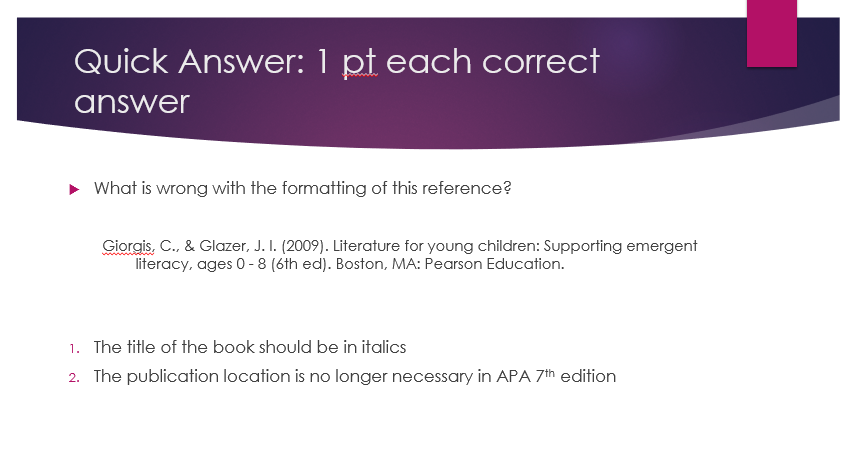
On the Board Bonus Point Examples:A picture containing text, screenshot, font

Description automatically generated

© Copyright 2024 AEJMC Public Relations Division

To cite this article: Sherrill, Lindsey A. (2024). APA Style: The Game. Journal of Public Relations Education, 9(2), 68-74. https://journalofpreducation.com/?p=4064

Mastering the Art of Brand Storytelling

Editorial Record: This article was originally submitted as an AEJMC Public Relations
Division GIFTs paper, with a February 2023 deadline. Top papers were submitted to
JPRE June 2023, and accepted for publication at that time. Published January 2024.

Author

Nicole O’Donnell, Ph.D.
Assistant Professor
Edward R. Murrow College of Communication
Washington State University
Washington, USA
Email: nicole.odonnell@wsu.edu

Overview of the Assignment

This assignment serves as an introduction to brand storytelling. Research suggests that storytelling is an essential tool for public relations professionals as stories can entertain, emotionally arouse, inform, and persuade audiences (Kent, 2015; McKee, & Gerace, 2018). However, students’ experiences with storytelling are often personal rather than strategic. For this assignment, I ask students to interview the leader or founder of a local nonprofit organization, business, or school club and use the information they gather to develop a compelling story. Students are instructed that the story should be written in a concise and accessible format that could easily be added to the client’s “about us” website or used in a backgrounder or other client communications.

Rationale

Nonprofit, small, or local organizations often lack the budget for professional communication services. When teaching service-learning classes, my students frequently identify opportunities for our community partners to have an improved web presence and share organizational stories with the public in meaningful and engaging formats. In our media-saturated environment, it is important for a brand to authentically communicate its unique points of difference (Pereira, 2019). Storytelling allows a brand to communicate its mission, vision, and values in ways that resonate with target audiences. 

Student Learning Goals:

  • Develop an understanding of effective brand storytelling and its potential to persuade, inform, entertain, and engage audiences.
  • Build confidence communicating with professionals in the field and practicing in-depth interview techniques.
  • Practice summarizing information and writing strategically for a public audience. 
  • Demonstrate the ability to write a compelling brand story based on interview data.
  • Create a professional work sample that highlights mastery of brand storytelling.

Connection to Public Relations Practice 

The USC Annenberg Global Communication Report (2017) identified digital storytelling as one of the most important future skills for marketing and public relations professionals. Furthermore, research suggests that authentic narratives drive brand perceptions and stakeholder engagement (Li & Feng, 2021). As such, this project is a unique way for students to enhance their career readiness and hone essential skills. 

This assignment is innovative because it provides students with the opportunity to establish their voices as strategic writers, develop their storytelling skills, and build their confidence speaking with business leaders. Additionally, the work that students produce for this assignment can be shared with the client and can also be added to the student’s professional portfolio. 

Assessment: 

Students are assessed based on creativity, narrative structure, organization, convention and style, and mechanics. In addition to turning in a written assignment, I ask students to create a five-minute presentation for the class to share their stories. These presentations also include experiential-learning reflection prompts in which students discuss their interview experiences.

Appendix

Assignment Description

Every organization has a story to tell, and learning how to tell that story effectively is an essential skill for public relations professionals. In this assignment, you will interview the leader or founder of a local nonprofit organization, business, or school club and use the information you gather to develop a compelling story. By conducting this interview, you will gain a deeper understanding of the organization’s culture, mission, and values, and learn how to translate that information to a broader public. 

Please conduct this interview via phone, Zoom, or in person. The interview should last around 20 minutes. Please ask for the interviewee’s permission to record the interview and use the attached email script and questionnaire as guides. Once you’ve conducted the interview, create a profile of the organization, as if you were writing an “about us” page for its website. Consider what answers stood out to you as interesting or unexpected, and how this story is unique or innovative. Your profile should be well-organized, grammatically correct, and visually engaging, with photos and quotes as appropriate to tell the organization’s story.

Additional Logistics:

Before scheduling your interview, please inform your professor about the individual you intend to interview within a week’s time. This step is crucial to ensure there are no duplicates and to respect the interviewee’s time. If you are contacting a business that you do not have a personal connection with, please consider using a version of the attached email script.

Example Email: 

Dear [Business Leader’s Name],

My name is [Your Name], and I am a student at [X university]. I am currently working on a school project that aims to capture the unique stories of local organizations, exploring their history, culture, values, and visions for the future. Your organization has always stood out to me as one that embodies the spirit and innovation of our community.

Given your role in shaping [Organization’s Name], I am interested in conducting a 20-minute phone or in-person interview with you for this assignment.  I will use the attached questionnaire as a guide during our conversation. Following the interview, I will craft an “about us” page for a website based on your responses. Your organization can use this if you choose to share your story.

If you’re willing to participate, please let me know a date and time that works best for you in the coming weeks. I will also be notifying my professor about the potential interview to ensure no duplicate efforts from my peers. Any resulting story I write will not be published or shared publicly without your explicit consent. Additionally, once the story is written, I will share a copy with you. 

Thank you for considering this request. Your insights and experiences would be invaluable to my project and my understanding of the work [Organization’s Name] is doing.

Interview Script: 

Thank you for taking the time to speak with me today. I’m excited to learn more about your organization and its history. Before we begin, I just wanted to confirm, is it okay if I record our conversation so that I can refer back to it later? Thanks again for meeting with me. Could you please introduce yourself and tell me a bit about your role within the organization? 

History 

  • Can you tell me about how you first became involved with the organization?
  • Do you know where your organization’s name came from? Is there a story there?
  • What was the organization’s first product or service?
  • What inspired the founders to start the organization?
  • What gaps or needs in the market did they seek to address?
  • From your perspective, how has the organization changed over time, and what events have shaped its development?

Values

  • Can you describe the organization’s culture and working environment?
  • What values or guiding principles have been important to the organization, and how have these been reflected in its actions and decisions?
  • Are there any traditions or rituals that the organization holds dear?
  • How does the organization view its relationship with its customers?

Challenges & Accomplishments

  • What have been some of the biggest challenges the organization has faced, and how were they overcome?
  • Were there any pivotal moments or turning points in the organization’s history?
  • What has been the organization’s proudest achievement to date?
  • How has the organization contributed to the broader community and industry?

Future Aspirations 

  • Where do you see the organization in the next 10 years?
  • What are the organization’s current goals, and how are these being pursued?
  • What long-term impact does the organization hope to have on its industry or the world?
  • What do you hope the future will hold for the organization?

Thank the interviewee for meeting with you and provide them with follow-up information.

References

Kent, M. L. (2015). The power of storytelling in public relations: Introducing the 20 master plots. Public Relations Review, 41(4), 480-489. https://doi.org/10.1016/j.pubrev.2015.05.011

Li, X. L., & Feng, J. (2021). Empowerment or disempowerment: Exploring stakeholder engagement in nation branding through a mixed method approach to social network analysis. Public Relations Review, 47(3), 102024. https://doi.org/10.1016/j.pubrev.2021.102024

McKee, R., & Gerace, T. (2018). Storynomics: Story-driven marketing in the post-advertising world. Hachette UK.

Pereira, G. (2019). Brand storytelling: A three-dimensional perspective. Journal of Brand Strategy, 8(2), 146-159. chrome-extension://efaidnbmnnnibpcajpcglclefindmkaj/https://www.henrystewartpublications.com/sites/default/files/JBS8.2BrandstorytellingAthreedimensionalperspective.pdf

USC Annenberg School for Communication and Journalism. (2017). Global Communications Report.     https://annenberg.usc.edu/sites/default/files/KOS_2017_GCP_April6.pdf

© Copyright 2024 AEJMC Public Relations Division

To cite this article: O’Donnell, Nicole. (2024). Mastering the Art of Brand Story Telling. Journal of Public Relations Education, 9(2), 83-90. https://journalofpreducation.com/?p=4034

Challenging AI in the PR Classroom

Editorial Record: This article was originally submitted as an AEJMC Public Relations
Division GIFTs paper, with a February 2023 deadline. Top papers were submitted to
JPRE June 2023, and accepted for publication at that time. Published January 2024.

Author

Erika J. Schneider, Ph.D.
Assistant Professor, Public Relations
S.I. Newhouse School of Public Communications
Syracuse University
New York, USA
Email: eschne03@syr.edu

Overview of the Assignment, Including the Rationale

The adoption of artificial intelligence has changed the public relations practice. AI is a technical development that has been praised in PR for its functionality and efficiency, such as by allowing professionals to automate and perform mundane tasks (e.g., Panda et al., 2019). Considering the projected growth in the employment of PR specialists, which is predicted to be 8% from 2021 to 2031, it is critical for PR educators to prepare students for the needs of the profession (U.S. Bureau of Labor Statistics; 2023). Krishna et al.’s (2020) survey of PR professionals found that senior managers, who may have more insight into the profession, considered new technology like AI to be more important for incoming communicators to have skills or expertise in, relative to middle managers. More recently, AI systems, such as OpenAI’s ChatGPT, Google’s BERT, and Microsoft’s Bing Chat, have advanced ways that professionals develop content (Larkin, 2023), although with limitations (OpenAI, 2023a). In preparing students for the profession, this activity encourages the discussion of the benefits and limitations of AI in PR writing.

In this exercise, students are asked to discuss the utility of artificial intelligence in public relations and evaluate an AI-assisted news release. Begin with a demonstration of how AI follows instructions in a prompt by inputting the following prompt in an AI system, such as chat.openai.com: “Who are the most successful PR professionals in history?” When providing this prompt in ChatGPT in February 2023, the following names were listed: Edward Bernays, Ivy Lee, Daniel J. Edelman, Betsy Plank, and Harold Burson (OpenAI, 2023b). Outputs vary each time the same question is asked. Share the results of the output with students and discuss who is represented and omitted on the list. If there are concerns regarding a lack of inclusive results, such as in the case where the output is dominated by a specific demographic group, there is an opportunity to discuss how the platforms reproduce bias while limiting the visibility and recognition of underrepresented communities.

After discussing representation, enter the following prompt: “Write a news release in AP style.” Ask students to evaluate the AI-assisted news release based on the quality of the content and structure (Ashcroft, 1994), and AP style (AP Stylebook, 2022). Appendix A provides an evaluation tool that has been adapted to the context of this activity. When providing this prompt in ChatGPT in February 2023 (Figure 1), the output did not adhere to AP style and the content and structure of the news release did not meet Ashcroft’s (1994) guidelines; however, outputs vary each time the prompt is entered. After students have an opportunity to evaluate the release, invite them to share observations, corrections, and recommendations. In addition to practicing copy editing, students develop a deeper understanding of how to incorporate AI tools in PR, question potentially problematic repeated bias, and consider the importance of PR professionals’ intervention to address outputs from machine-based systems.

Figure 1. Example of an AI-assisted news release from ChatGPT (OpenAI, 2023c).

Connection to Public Relations Practice and/or Theory

There are risks and benefits to public relations professionals embracing the diffusion of AI technologies. While the benefits include efficiency in automating tasks, the risks, such as concerns regarding privacy and inaccuracies, and long-term societal impacts of AI are less understood (Wilson & Van Der Velden, 2022). Within PR research, the ethical implications of AI’s disruption in PR practices have been considered, such as transparency in AI-assisted communication (e.g., Bourne, 2019). 

As tools are adopted into PR practices, there is value in exposing students to relevant tools and skill sets. This in-class exercise applied ChatGPT, but other AI systems may be utilized in this activity. Machine learning and AI platforms and services evolve with new technologies, access, and user preferences. Although the interface may vary, the foundational concepts are applicable across technologies and the understanding of functions is transferable.

Student Learning Goals

1. Understand the benefits and assumptions of AI-assisted communication.

2. Demonstrate knowledge of the principles of PR writing in AI-assisted communication.

Evidence of Learning Outcomes/Assessment

This in-class activity appeals to students in PR courses. Applying this technology in classrooms has been found to motivate and engage students, which is a driver of learning (Haggerty & Davis, 2019). Per feedback on this assignment, students were excited to gain experience with AI and appreciated the assessment of best practices of PR writing. Generally, the students shared that they were familiar with AI but had not questioned or evaluated AI responses to PR writing prompts prior to this assignment, which changed their perspective of its utility. When asked to share their observations and recommendations, students gained confidence in their writing and critical thinking skills. When students discussed deficiencies in the AI-assisted news release, they also recognized the importance of gaining PR expertise to navigate future technological developments.

References

Ashcroft, L. S. (1994). Effective press releases. Library Management, 15(8), 24-27. https://doi.org/10.1108/01435129410071372

The Associated Press. (2022). The AP Stylebook: 56th edition. The Associated Press.

Bourne, C. (2019). AI cheerleaders: Public relations, neoliberalism and artificial intelligence. Public Relations Inquiry, 8(2), 109-125. https://doi.org/10.1177/2046147X19835250

Haggerty, R., & Davis, L. E. (2019, July 11). Can chatbots teach copy editing? A comparison of student reporters’ copy editing performance when using a chatbot style guide and a traditional stylebook [Research paper]. World Journalism Education Congress 2019, Paris.  http://www.wjec.paris/wp-content/uploads/2020/05/WJEC_proceedings_V2_Final.pdf

Larkin, E. (2023). ‘A starting point for creativity:’ How PR pros are testing ChatGPT. PR Week. https://www.prweek.com/article/1810757/a-starting-point-creativity-pr-pros-testing-chatgpt

OpenAI. (2023a). ChatGPT: Optimizing language models for dialogue.      https://openai.com/blog/chatgpt/

OpenAI. (2023b, February 12). [ChatGPT response to a prompt about the most successful PR professionals in history.] https://chat.openai.com/

Panda, G., Upadhyay, A. K., & Khandelwal, K. (2019). Artificial intelligence: A strategic disruption in public relations. Journal of Creative Communications, 14(3). https://doi.org/10.1177/0973258619866585.

Krishna, A., Wright, D. K., & Kotcher, R. L. (2020). Curriculum rebuilding in public relations: Understanding what early career, mid-career, and senior PR/communications professionals expect from PR graduates. Journal of Public Relations Education6(1), 33-57. https://aejmc.us/jpre/2020/01/21/curriculum-rebuilding-inpublic-relations-understanding-what-early-career-mid-career-andsenior-pr-communications-professionals-expect-from-pr-graduates/

U.S. Bureau of Labor Statistics. (2023). Public relations specialists: Job outlook, 2021-31. https://www.bls.gov/ooh/media-and-communication/public-relations-specialists.htmWilson, C., & Van Der Velden, M. (2022). Sustainable AI: An integrated model to guide public sector decision-making. Technology in Society, 68. https://doi.org/10.1016/j.techsoc.2022.101926

Appendix A

Evaluation tool

Evaluate AP style using the AP Stylebook (2023), and the content and structure of the news release using Ashcroft’s (1994) adapted guidelines. The guideline for evaluating the news release is in the right column, and students may provide evaluations of the guideline to be discussed in the right column.

GuidelineStudent Evaluation
Use of AP style
Is the release clearly headed with “Press Release” or “News Release” in large, bold letters?
Does the release display the name of the organization?
Does the release display an address for the organization?
Does the release display information to contact the organization?
Does the release contain an embargo or date of release?
Does the release contain a bolded headline that could catch the eye of an editor? Is it written in present tense, not too gimmicky or puzzling, and indicate the nature of the story in as interesting a way as possible?
Does the opening paragraph include information on the what, the who, the where, the why and the when, in such a way as to make as much impact as possible?
Does the release tell the facts and put them in descending order of importance?
Does the release contain a quotation that provides additional interest and is it given by someone who has authority to speak on the matter?
Does the release contain no more than three quotes?
Does the release contain vigorous language to convey vitality?
Is the end of the release recognized by the word “ENDS” or another indication (e.g., ###)?

© Copyright 2024 AEJMC Public Relations Division

To cite this article: Schneider, Erika J. (2024). Challenging AI in the PR Classroom. Journal of Public Relations Education, 9(2), 60-67. https://journalofpreducation.com/?p=4052